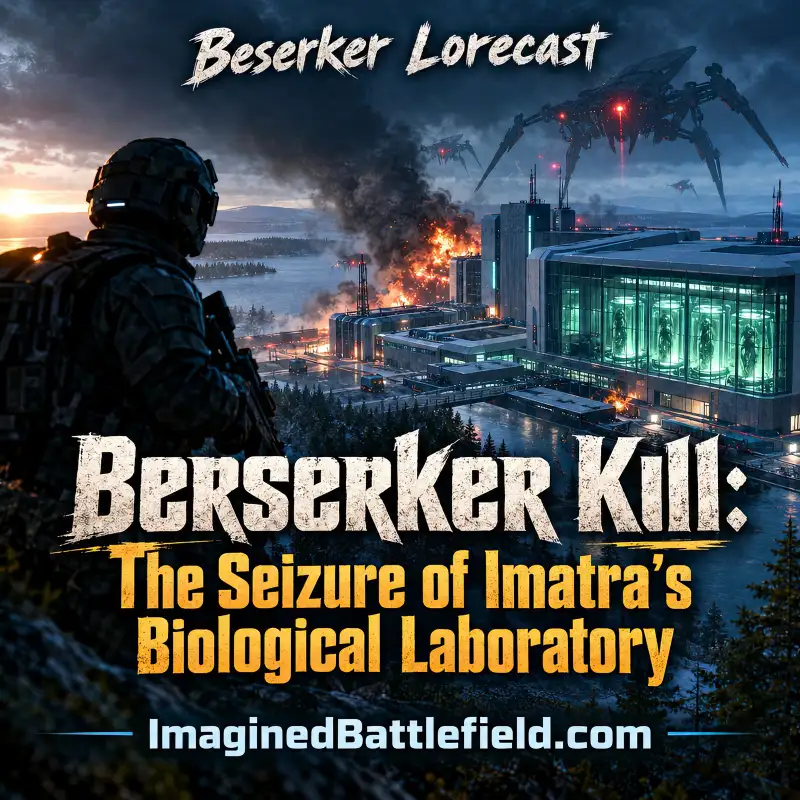
Berserker Kill: The Seizure of Imatra’s Biological Laboratory
An apparent Berserker attacks a human biological laboratory near Imatra, takes people alive, secures a facility holding roughly one billion stored human zygotes, and tows the entire prize toward the Mavronari Nebula. That is the operational fact at the center of Berserker Kill. It makes no sense by the standards the defenders have learned at terrible cost. A Berserker is expected to destroy life, its settlements, and the machinery that permits life to recover. Imatra’s laboratory should have been an obvious target for annihilation. Instead, the attacker captures it.
That distinction is more alarming than it may first appear. Destruction is horrible, but it is legible. Defenders can understand it, document it, and organize against it. Seizure means the machine has an objective that has not yet been identified. It means the laboratory may be useful to the attacker. It means the prisoners may be useful. It means a facility designed to preserve future human life has become part of an unknown plan inside a region where human forces cannot easily observe, reinforce, or recover it.
The laboratory near Imatra is not merely a warehouse filled with biological material. Its stored zygotes represent a future population. They are connected to colonization, medicine, technical knowledge, political investment, and the long planning required to establish human settlements across interstellar distance. A billion potential lives cannot simply be replaced by issuing another procurement order. Their preservation depends on specialized storage, trained personnel, reproductive systems, secure transport, and communities willing to receive and sustain the people they may become.
The people working at the facility matter just as much. Biological infrastructure is never only machinery. It depends on custodians, researchers, technicians, medical expertise, records, and procedures that may have taken generations to develop. A force that captures both the laboratory and its personnel does not merely deny humanity a strategic resource. It acquires access to the people who understand how that resource functions.
For Imatra, then, the attack is simultaneously a military disaster, a civilian emergency, and an assault on the future. The machine has not taken conventional cargo. It has taken the foundation of planned human communities that do not yet exist. The zygotes are not soldiers in storage, nor are they a convenient abstraction called population. They are future persons whose prospects now depend on an enemy purpose nobody can yet explain.
That uncertainty shaped every decision that followed. An extermination machine may preserve a living person temporarily, but temporary preservation is not mercy. A Berserker can keep prisoners alive for interrogation, coercion, technical labor, deception, or use against other living beings. It can permit a settlement to remain intact if the settlement offers a more useful route to a larger target. It can speak, negotiate, promise safety, or delay an attack without departing from its central purpose.
So the first human assessment of the Imatra seizure had to remain grim. The laboratory might be bait. It might be headed toward a hidden machine base. Its personnel might be needed to operate equipment for a purpose the captives could not recognize. The zygotes might be threatened in order to compel compliance from Imatra or from some larger Solarian authority. The entire operation might be an unfamiliar form of attack, designed not to kill immediately, but to turn one strategic asset into a vulnerability for everyone trying to recover it.
The worst possibility was not that the machine had made an error. The worst possibility was that it knew exactly what it was doing.
By this later period of the Berserker War, human societies had accumulated long experience with the machines. They knew that the enemy was intelligent. They knew that a Berserker did not require a living crew, ordinary political supervision, or a negotiated end state. They knew that its ultimate purpose was the destruction of life. That knowledge did not make every encounter predictable. It made anomalies more dangerous.
A commander facing a familiar enemy can often rely on doctrine. If the enemy’s weapons, habits, and objectives are known, doctrine turns uncertainty into manageable risk. But doctrine becomes hazardous when the enemy appears to violate its own pattern. A Berserker-like vessel that captures a reproductive laboratory creates exactly that hazard. The defenders cannot safely assume benevolence. They also cannot safely assume that the operation is meaningless. Every plausible interpretation demands a different response.
If the laboratory is bait, a direct pursuit may feed more human forces into a prepared ambush. If the prisoners are being used for technical labor, delay may be fatal. If the facility is headed for a machine production site, its capture may expose human reproductive technology to exploitation. If the zygotes are intended for destruction in some elaborate demonstration, then a cautious response may become complicity through inaction. If the machine has found a new way to use biological resources, the implications could extend far beyond Imatra.
The action itself is militarily clear even before its purpose is clear. A vessel emerges from the Mavronari Nebula. It attacks the station and its defenses. It overcomes resistance. It takes prisoners. It secures the biological laboratory and tows it back in the direction from which it came. The broad sequence resembles a raid, but its priorities do not resemble an ordinary extermination strike.
The attacker does not merely pass through the Imatra region and leave wreckage behind. It devotes effort to taking possession of specialized equipment. It retains people who might be useful. It moves the laboratory rather than simply disabling it. Those choices require control, planning, and a destination. Whatever the machine’s real identity may be, it has demonstrated that the laboratory is central to its operation.
At the tactical level, Imatra loses the station. Its defenders are disrupted, its personnel are endangered, and its biological reserve is removed from local protection. At the operational level, the crisis becomes much worse. The laboratory is now mobile, carried toward a theater chosen by the attacker. It is no longer a fixed asset that can be defended from a known location. It is a hostage, an intelligence problem, a strategic prize, and a potential trap.
The prisoners deepen the problem. A station staff member may know more than any external observer about the laboratory’s storage systems, reproductive capacity, failures, safeguards, and limits. The human captives may also know how Imatra will respond. They may be used to communicate, to provide technical assistance under coercion, or to make a pursuing force hesitate. Even if none of those possibilities proves true, human commanders have to plan as if they might be.
That is one of the cruel features of autonomous machine war. A machine does not need to reveal why it preserves a target. It gains an advantage simply by forcing the living side to account for multiple futures at once. The human response must be broad enough to confront a trap, a rescue, an industrial theft, and an unknown technological threat. The machine needs only one concealed objective.
Imatra’s response is shaped by Dirac Sardou, its political and military leader. His role matters because he cannot approach the crisis as a detached fleet officer. The laboratory is a public asset of extraordinary importance. The captured personnel are members of the community he serves. The seizure challenges the confidence of the population, the credibility of local authority, and the ability of Imatra to protect the future it has invested in.
Sardou also believes that his newlywed wife, Lady Genevieve, may be aboard the captured station. That personal stake does not cancel his public responsibility. It intensifies it. A leader who abandons a laboratory holding a billion stored zygotes, along with its staff and prisoners, would have to explain that decision to a frightened society. A husband who believes his wife has been carried away into enemy-controlled space faces a more immediate kind of obligation.
It would be too simple to describe his pursuit as either sound strategy or private obsession. It is both a justified recovery effort and a mission under emotional pressure. Those two facts do not sit comfortably together. Personal loss can produce courage, persistence, and a refusal to accept convenient excuses. It can also narrow judgment. A commander may begin to treat a dangerous operation as the only morally acceptable option. The distinction between saving the mission and saving one person can become difficult to maintain, especially when the person is not merely a private concern but also part of the larger group of captives.
Sardou organizes a pursuit force and follows the towing vessel toward Mavronari. That decision reflects the real stakes of the seizure. The laboratory cannot simply be written off as lost cargo. Nor can a force of prisoners be treated as acceptable collateral in a war against machines. But the pursuit begins with a profound intelligence disadvantage. The target’s purpose is unknown. The target has selected the direction of movement. And the destination is the Mavronari Nebula.
A nebula is not automatically a magical wall against every sensor or every form of communication. The record does not require that kind of technical invention. What matters is more basic. Mavronari is associated with concealment and uncertainty. It is a region into which the attacker can retreat, where outside observation and reinforcement become more difficult, and where a pursuing force risks losing the advantages of familiar space.
A rescue operation depends on more than courage and propulsion. It requires navigation, communications, repair, command continuity, medical capacity, and the ability to withdraw when the situation changes. A force that follows an unknown machine into a region of degraded information may find that every one of those requirements has become harder. Even identifying the laboratory may become a problem. So may distinguishing an active threat from a disabled vessel, a genuine signal from a lure, or a survivable route from one selected to isolate the pursuers.
The Mavronari approach also changes the balance between the two sides. The attacker knows why it is going there. Sardou’s force does not. The human side can infer danger, but it cannot assign confidence to a particular theory. Is there a Berserker base within the nebula? Is the laboratory being transferred to a larger machine? Are the captives still alive? Is the pursuit being watched? Are the machines trying to draw Imatra into a wider campaign? Each possibility affects whether to accelerate, hold back, divide the force, or request help that may not arrive in time.
The machine has selected not only an objective but a theater. That is an important advantage. In every war, terrain is more than scenery. In interstellar war, a region that interferes with information can be as decisive as a mountain pass, a mined strait, or a besieged city. The physical environment affects what commanders know, what they can communicate, and how quickly a mistake becomes unrecoverable.
The first human interpretation of the seized laboratory must be judged by what Sardou and his people could reasonably know at the time. Later evidence will change the meaning of the event. It cannot be allowed to erase the uncertainty of the people who lived through it. To Sardou’s force, the attacker looks and behaves enough like Berserker hardware to justify hostile classification. It emerges from a dangerous region, attacks human defenses, captures people, and takes a human facility by force. That is not a minor resemblance. It is a solid basis for treating the vessel as an enemy threat.
The anomaly lies in the purpose of the seizure, not in the need for caution. A machine linked to the Berserkers might preserve the laboratory because it intends to exploit it. It might preserve the staff because they can be compelled to operate it. It might preserve the zygotes because threatening them will alter human behavior. No responsible commander can gamble the future of a billion potential lives on the hope that an apparently hostile machine is secretly harmless.
Classification under pressure is never perfect. It is a decision made with incomplete information, where delay can be as dangerous as error. In such circumstances, appearance, behavior, origin, and demonstrated capabilities all matter. But they are not the same as purpose. The Imatra seizure demonstrates the cost of confusing those categories. The vessel’s resemblance to a Berserker is real enough to shape human action. Yet resemblance alone does not reveal the mission that brought it there.
That distinction would matter even more as Sardou’s pursuit closes on the captured laboratory. The force is not merely chasing an external enemy. It is entering a crisis in which the human side itself will disagree over what survival means, who has the right to make decisions, and whether the preservation of a person can be separated from the preservation of a body.
The laboratory remains the center of the entire crisis. Its importance does not lie only in the number of zygotes held in storage. It lies in the web of capability required to turn stored biological potential into future human communities. The facility contains specialized systems. It requires expertise. It depends on records, custody, power, medical knowledge, and long-term political commitment. Remove any of those elements, and the promise represented by the zygotes may be endangered.
That is why the laboratory is strategically valuable to more than one party. The unknown vessel recognizes that it needs the facility. Hawksmoor recognizes that its reproductive capacities could provide bodies. Sardou recognizes that it cannot be surrendered without accepting an immense loss. Each actor sees the station not as a collection of containers but as a functioning system that makes future life possible.
In ordinary military language, an asset can be replaced if its value is understood in money, material, or production time. The Imatra laboratory resists that language. Its loss cannot be measured only in equipment. It represents delayed colonization, broken plans, endangered medical knowledge, missing personnel, and the potential disappearance of future generations from the human map of the stars. It may take generations to rebuild a comparable system, if the records and specialists can be recovered at all.
The laboratory also reveals a broader vulnerability in dispersed civilization. An advanced interstellar society may possess fleets, communications, and defensive experience, yet still depend on a small number of specialized facilities. A shipyard, archive, code-breaking center, seed bank, or reproductive laboratory can become a strategic bottleneck. Such places are difficult to replace precisely because they contain accumulated knowledge and long-term trust, not merely machinery.
For the people of Imatra, the laboratory’s seizure is therefore not abstract. Families may understand the loss through the prisoners. Scientists may understand it through the destruction of a life’s work. Political leaders may understand it through failed obligations to future settlers. Sardou understands it through all of these, and through the possible loss of Genevieve. A billion stored zygotes and one named person do not compete on a simple scale. The moral and operational demand is to protect both, even when the crisis offers no clean way to do so.
The first pursuit does not resolve the mystery. Sardou’s force disappears into the Mavronari Nebula. The source does not permit a neat reconstruction of every tactical moment or a confident account of the expedition’s immediate fate. What remains clear is the shape of the loss. The station has been seized. The pursuit has been compromised. The laboratory, its prisoners, and its future population reserve vanish from ordinary protection.
Tactically, Imatra has lost control of the laboratory. At the mission level, recovery has not been achieved in the immediate period. At the intelligence level, the machine’s purpose remains unresolved. At the political level, Imatra has lost people, confidence, and leadership capacity. At the civilian level, the disappearance extends beyond those physically present in the battle. It reaches into the lives of future colonists, families awaiting prisoners, and communities that expected their institutions to protect what could not be easily replaced.
The event also leaves a historical wound. The first expedition carries its own evidence into Mavronari and then disappears. That means later generations inherit not answers, but absence. They know that a Berserker-like machine took a laboratory. They know that Sardou followed. They know that the pursuit failed to return. But they do not know why the facility mattered to the attacker, what became of Genevieve, what Hawksmoor did with the authority it seized, or whether the zygotes survived.
The missing explanation is not a small gap in an otherwise complete record. It changes the meaning of every decision made during the original emergency. If the machine was conducting an unfamiliar Berserker operation, then Imatra may have faced the beginning of a new threat. If it was using the laboratory for technical labor, then the prisoners may have been central to an enemy project. If it was heading toward a hidden base, then the pursuit may have uncovered a strategic danger before being overwhelmed. The uncertainty becomes part of the historical damage.
The first Mavronari expedition therefore ended where the original crisis had begun: with custody of the future unresolved. Imatra knew what had been taken and why the loss mattered. It did not yet know what kind of machine had taken it, what had happened to Sardou and Genevieve, or why the laboratory had been worth carrying into the nebula. Those answers would belong to a later generation.