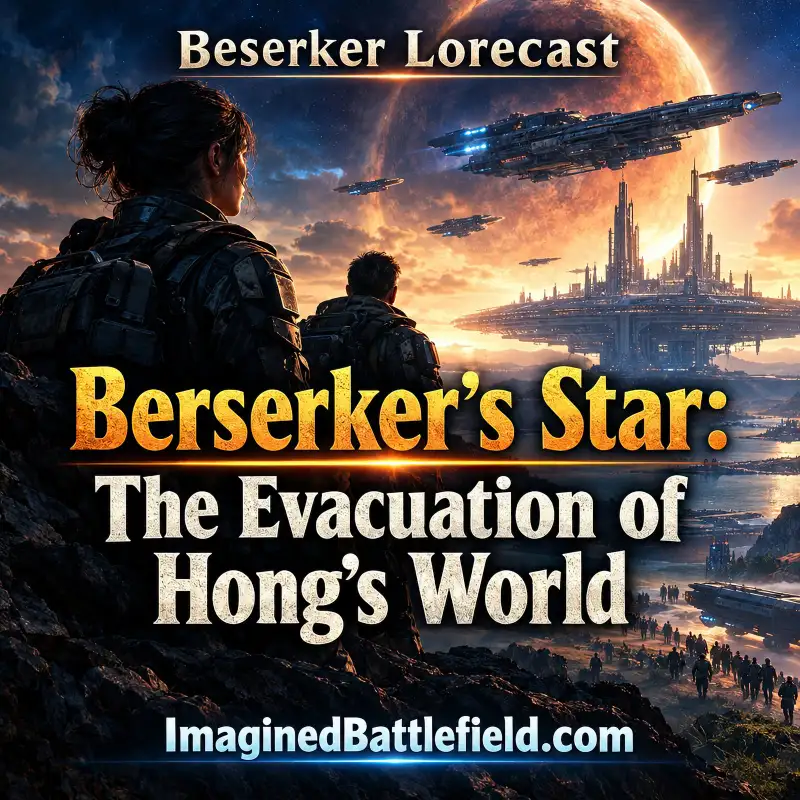
Berserker’s Star: The Evacuation of Hong’s World
People left Hong’s World carrying what they could carry. Some went on foot. Some rode in slow vehicles through the gathering traffic. They took household objects, personal tools, family possessions, things with little mass value and enormous private value. Above them, ships were assembling in numbers large enough to promise escape, but not enough to make departure feel ordinary. A world was not being abandoned because its government had fallen, or because an enemy army had crossed a border. Its sun had become the threat. The population had been told that the system would no longer remain a place where human life could endure.
That warning changed every familiar measure of distance. A house became something that had to be left behind. A job became an uncertain future on another world. A local government became an institution trying to preserve its people while its territory ceased to be habitable. Every person moving toward a landing field or embarkation point became part of a vast transportation problem. They also became part of something more personal. They were deciding which fragments of a former life could still have meaning after the planet beneath them was gone.
Hong’s World had only one habitable planet in its system. There was no nearby sister world to receive the displaced population, no internal migration route that could preserve the old society in familiar territory. The population had to leave the system, or at least leave the path of the coming disaster. That made the evacuation an act of survival, but survival was not a simple matter of getting bodies into available seats. A million people could survive physically and still lose homes, records, property, relationships, occupations, political representation, and confidence in the future.
The scene is orderly enough to be remarkable. There is strain, there is urgency, and there is the unmistakable pressure of a deadline. But Hong’s World is not shown dissolving at once into panic. People move. Authorities organize. Ships arrive. The fact that citizens still carry personal possessions tells us something important. They have not yet been reduced to anonymous cargo. They are still trying to preserve continuity, even while accepting that the physical setting of their lives cannot be saved.
That distinction matters in the Berserker Wars. The machines seek the destruction of life, but living civilizations do not defend themselves merely by keeping biological organisms alive for another day. They defend families, memories, future children, local loyalties, knowledge, and the ability to choose a life not dictated by an extermination system. Hong’s World is therefore not simply a disaster zone. It is a civilian society attempting to move itself through space before the destruction of its sun becomes the destruction of everything that society has built.
The first decisive resource in that effort is warning time. A ship can carry only so many people. A government can issue only so many orders. A landing field can process only so much traffic before congestion becomes dangerous. None of those limits can be eliminated by courage. They can only be managed if the population learns of the threat early enough to act. Hong’s World receives that chance because the coming stellar catastrophe is detected before its most destructive effects arrive.
The novel’s warning chain belongs to its own fictional framework. Automatic sensors detect particles moving at nearly the speed of light. Neutrinos, passing through the star, provide an earlier indication that something catastrophic is happening. A robotic courier capable of superluminal travel carries the warning onward. This is not a lesson in real astrophysics, and it should not be treated as one. Its historical importance in the story is simpler. The warning arrives in time to turn certain destruction into a difficult evacuation.
That difference is enormous. A disaster detected at impact leaves no room for strategy. It produces only local acts of survival. A disaster detected early enough creates a period in which institutions can function. Calls for assistance can be sent. Ships can be redirected. Civilian authorities can establish embarkation procedures. Families can be told where to report. Medical cases can be identified. People can make choices about possessions, dependents, and destinations. Warning does not solve the crisis, but it creates the possibility of organized response.
In military terms, warning time is a form of operational depth. It gives defenders space in time rather than space on a map. Hong’s World cannot move its planet. It cannot negotiate with a nova. It cannot defeat the sun with a fleet. But it can use advance knowledge to move life away from the point of destruction. That is an achievement of sensors, communication, administration, and public discipline. It is also an achievement that depends on people believing the warning and acting before the danger is visible.
The scale of the operation is substantial. Hong’s World has roughly one million inhabitants, and more than one thousand ships are mobilized from nearby systems within days. Those figures describe this particular emergency. They do not establish a standard evacuation ratio for the wider human sphere, and they do not tell us the capacity of every vessel involved. But they do establish the basic fact: this is not an improvised escape by a few hundred survivors. It is a large interstellar movement of civilians under severe time pressure.
A million people require more than transport hulls. They require staging areas, schedules, embarkation control, and some way of deciding who boards which ship. They require medical support for people who cannot simply climb a ramp and find a seat. They require provision for children, the elderly, the injured, and those whose work makes them essential to the evacuation itself. They require crews who can continue operating while their own families may be among the displaced. They require records, even imperfect ones, because a society that loses its people’s identities and obligations may survive only as a collection of strangers.
Cargo creates another problem. Every item carried aboard consumes space, handling time, and attention. Yet it would be a mistake to dismiss personal belongings as frivolous baggage in a crisis. A tool may be the basis of someone’s future work. A document may establish a legal claim. A family object may be the only surviving link to a dead relative or a vanished community. People fleeing Hong’s World cannot preserve everything. The choices forced on them are part of the disaster. An evacuation manifest can count passengers. It cannot measure what they have been required to abandon.
The larger question is destination. Getting people off a dying world is only the first phase of survival. They must go somewhere. They must be received by other communities, or dispersed among settlements able and willing to take them in. They will need work, housing, food, medical care, schools, legal standing, and some chance to rebuild civic life. The ships gathering above Hong’s World can save lives from the immediate catastrophe. They cannot automatically preserve the society those lives came from.
That is why the evacuation cannot be understood as a simple shipping exercise. It is a forced redistribution of a population. It may preserve the people of Hong’s World while dissolving the old pattern of their lives. The emergency creates new burdens for every destination system. It also creates political questions. Who has authority over displaced citizens? Who controls property left behind? Which institutions remain legitimate after their territory has become uninhabitable? Those questions do not need to be answered before the first ships depart. But they will wait for the survivors.
At the center of the public response are two separate institutions, the Space Force and the Templars. The opening presents them as cooperating effectively during the crisis. That cooperation deserves credit. It is tempting, especially in stories of disaster, to assume that formal authority must fail so that an independent hero can save the day. Hong’s World offers a different picture. The large evacuation is possible because organized institutions are doing their work well enough to assemble ships, manage traffic, and move civilians before the deadline closes.
The Space Force and the Templars are not treated here as interchangeable names for one universal military establishment. They are distinct organizations, and the fact that they are working together smoothly is notable. The suggestion that such cooperation is unusual tells us there may be institutional separation, different traditions, or ordinary bureaucratic friction. It does not prove permanent hostility, and it does not establish a single constitutional order governing every human world. It simply shows that, on Hong’s World, the emergency has produced practical coordination.
We should be careful not to invent a detailed command chart. The available evidence does not tell us which office controls every launch field, which service assigns every escort, or how authority is divided at each stage of the movement. But the public operation plainly requires traffic control, security, prioritization, communication, and discipline. Someone must keep arriving ships from colliding in their urgency. Someone must prevent boarding areas from becoming sites of fear and rumor. Someone must make sure that the last people needed to operate the evacuation are not left behind by the first wave.
This is what institutional capacity looks like under pressure. It is not glamorous. It is not a single decisive duel. It is a thousand necessary acts completed in the correct order. A dispatcher assigns a berth. A crew accepts another load of frightened civilians. A local official keeps a road open. A medical worker decides who needs immediate care. A security officer distinguishes a genuine instruction from a rumor. A pilot waits for clearance rather than creating another emergency. The survival of a million people depends on this unheroic competence.
But organization on the ground and in orbit solves only the first problem. It gets people away from the planet. It does not make them safe once they are moving through a region where Berserkers may operate. In fact, success creates a new form of danger. The population of Hong’s World is no longer dispersed across cities, farms, workplaces, and shelters. It is concentrated into ships, loading routes, orbital lanes, and departure schedules. What had been a civilization spread across a planet becomes a visible pattern.
That pattern is dangerous because Berserkers are built to destroy life. A machine does not need to feel anger at refugees to recognize their vulnerability. It only needs to identify a concentration of living targets, determine that those targets can be reached, and calculate that an attack serves its mission. The emotional language humans naturally use around catastrophe can obscure that point. The danger is not that a machine takes personal offense at civilians fleeing a nova. The danger is that a refugee convoy presents a highly efficient target.
Harry Silver understands the possibility. Many of the ships involved in such an evacuation are not purpose-built warships. Some have limited defensive protection. Some are commercial hulls, private vessels, transports, or whatever can be brought to Hong’s World quickly enough to matter. Their strength lies in numbers and availability, not in combat power. They are carrying people because people need to be moved, not because the ships were assembled for a fight.
A civilian exodus therefore creates three linked problems. The tactical problem is the safety of individual ships. A lightly defended transport can be destroyed, disabled, or forced off course. The operational problem is route security. Ships leaving the same system may be forced into predictable corridors, staging points, or traffic patterns. The strategic problem is larger still. If a Berserker force can destroy a significant share of an evacuated population, it may erase not only lives but also the future recovery of a world’s people.
Harry Silver arrives in the middle of this public emergency from a position well outside the official chain of command. He owns and operates the Witch of Endor. He is an independent pilot, not a Space Force officer and not a Templar subordinate. He arrives carrying specialized machinery that he expects to sell. Under ordinary circumstances, that cargo might represent profit. Under evacuation conditions, the local market is collapsing along with every other routine assumption about commerce.
Harry’s immediate problem is practical before it becomes moral. He has a ship, cargo in the hold, and a strong interest in keeping both under his own control. He also has reason to worry that the emergency may turn his vessel into an asset that someone else expects to use. Private ships are valuable during evacuations precisely because they are mobile and available. But the owner of a private ship may have contracts, cargo, debts, legal trouble, and destinations that do not disappear because a public crisis has begun.
That makes Harry neither a villain nor an uncomplicated hero. His reluctance to become another refugee transport is understandable. The Witch of Endor is his livelihood, his means of freedom, and his protection in a dangerous region of space. At the same time, private control of useful transport is always politically sensitive during a mass emergency. A government responsible for a million civilians will see available hull space as a life-saving resource. The shipowner will see the same space as property, risk, and the basis of future survival.
Independent operators matter because they can do things formal institutions cannot always do quickly. They can take unusual contracts. They can move through commercial networks. They can act where official forces are delayed, constrained, or unwilling to assume a particular risk. But independence also means limited accountability. An independent pilot can choose a mission for personal reasons. He can refuse one. He can carry passengers whose motives are not fully known. He can become important because he is outside the system, and dangerous for exactly the same reason.
Harry’s position is further complicated by the c-plus cannon. The Space Force wants him in connection with his taking of that powerful weapon. The details of the case are not fully adjudicated in the opening, and it would be wrong to turn the episode into a legal verdict on Harry’s conduct. What matters here is that the cannon gives him a reputation. It is evidence of a history that makes him both notable and vulnerable in the presence of Space Force authority.
The cannon is not merely a piece of equipment. It is leverage. A weapon with that kind of reputation may make Harry seem useful to people who anticipate danger. It may also make him appear irresponsible, politically inconvenient, or worth pressuring. The Space Force’s interest in him exists alongside the immediate evacuation rather than being erased by it. That is a useful reminder that emergency unity does not dissolve every older dispute. A civilization can mount a competent rescue operation while still carrying unresolved arguments over authority, weapons, and jurisdiction.
We should resist the urge to turn the c-plus cannon into a technical specification. The event does not require us to know its exact range, yield, or place in fleet doctrine. Its importance is social and political. It affects how other people view Harry. It creates a point of vulnerability when he needs to preserve control of his ship and choose his own destination. In war, a weapon can matter long before it is fired. Its reputation may influence decisions, alliances, threats, and bargains.
Harry’s situation becomes more complicated when he receives warnings about Maracanda. A Templar colonel advises him not to travel in that direction. A Space Force captain gives him a separate warning. The agreement between those two officials matters. They come from institutions that are distinct enough for their cooperation at Hong’s World to be noteworthy, yet both signal that Maracanda is dangerous. Their warnings indicate that the region is associated with Berserker activity and that travel there is not being treated as ordinary commercial movement.
The officials do not provide Harry with a complete intelligence briefing. Their warnings are not a full map of every danger beyond Hong’s World. They establish risk, not certainty. That limitation is important. In the Berserker Wars, commanders, civilians, and independent pilots often act with incomplete information. The fact that authorities know enough to advise caution does not mean they know enough to guarantee safety, explain every motive, or control every vessel that chooses to depart.
Maracanda therefore enters the story as a destination marked by uncertainty. It is dangerous enough that both a Templar officer and a Space Force officer advise against it. It matters enough that people are willing to take the risk of going there. But at this moment, neither Harry nor the listener has been given a full explanation of why it will matter. The warning is an intelligence signal. It tells Harry that he is being offered a choice whose consequences may be larger than the payment in front of him.
The people offering that payment are three prospective passengers. Lily Gunnlod says she is trying to reach her husband, Alan Gunnlod. Her purpose is personal, urgent, and emotionally legible. She is not simply fleeing a dying world in search of any available refuge. She has a particular destination and a particular person she believes she must reach. Her situation is connected to allegations involving abduction or cult influence, though the full reality is not yet transparent to Harry.
The other two passengers call themselves Redpath and Dietrich. They also have urgent business on Maracanda, but their reasons are less clear at the outset. They are not best understood as identical refugees merely because they are leaving Hong’s World under emergency conditions. They have their own objectives, their own knowledge, and their own reasons for wanting passage aboard the Witch of Endor. Harry knows that they are prepared to pay. He does not know everything that lies behind their urgency.
This is where a public evacuation turns into a private intelligence problem. Harry has three people who want to travel with him. One appears motivated by the search for a husband. Two have business that remains partly concealed. They have selected Harry’s ship rather than simply joining the broader outflow from Hong’s World. That choice may reflect the Witch of Endor’s capabilities, Harry’s reputation, the route they want to take, or information they have not yet shared.
Redpath’s awareness of the c-plus cannon adds another layer. Knowledge of Harry’s legal vulnerability may be useful to a passenger who wants influence over his decision. It may be a point of pressure. It may be an implied threat. But the opening does not establish a formal blackmail scheme, and it would be too simple to describe every reference to Harry’s past as outright coercion. What matters is that the passengers do not approach him as strangers with no leverage. They know enough about him to make his freedom part of the negotiation.
Harry must decide what the three passengers represent. They are fare-paying customers. They are potential complications. They may carry information. They may bring danger aboard his ship. They offer him a reason to leave a crowded system where the local economy has been overturned and Space Force attention may become inconvenient. At the same time, their destination is the very region that two authorities have warned him to avoid. The money is real. So is the risk.
The decision is morally ambiguous in a useful way. A ship such as the Witch of Endor could potentially contribute to the mass evacuation. In any catastrophe, a civilian vessel capable of carrying people seems to acquire an obvious obligation. But Harry is not standing beside a collapsed rescue system. More than one thousand ships have been mobilized. The Space Force and Templars are cooperating. The public operation is presented as likely to get the population away from Hong’s World. Harry’s departure is not the difference between a functioning evacuation and universal abandonment.
That does not make his choice irrelevant. It means the choice belongs to a different category. Harry is not replacing public institutions. He is operating at their margin. The large evacuation is dealing with the immediate task of moving a million people away from a dying sun. Harry is offered a smaller mission, directed toward a place the larger operation cannot simply absorb into its own priorities. The passengers’ urgency, the warnings about Maracanda, and Harry’s precarious legal position converge in a decision that no evacuation manifest can make for him.
He accepts the substantial fee and takes the passengers toward Maracanda. In doing so, he chooses not to become merely another transport in the broad civilian movement. That choice should not be described as a rejection of Hong’s World’s people. The public effort already has organized capacity. Harry’s ship, cargo, reputation, and freedom create a separate set of circumstances. His decision sends one vessel along a route defined by private loyalty, commercial calculation, incomplete intelligence, and a danger that official voices have made plain without fully explaining.
This is a familiar but often misunderstood feature of wartime societies. Institutions need independent actors, even when they do not entirely trust them. A Space Force can organize a large evacuation. Templars can contribute authority and military discipline. Neither organization can foresee every personal obligation, commercial connection, or fragment of intelligence moving through civilian space. An independent pilot can reach places and take contracts that formal systems do not control. That flexibility can be useful. It can also create risk, especially when the pilot’s passengers have their own concealed purposes.
The public and private strands of Hong’s World should not be set against one another too neatly. The evacuation requires order. Harry’s mission requires discretion. The evacuation moves a population away from immediate destruction. Harry’s mission moves toward a danger that others have warned him about. One is collective preservation at scale. The other is an individual decision shaped by particular people and particular pressures. Both arise from the same strategic environment, where every route through space may connect civilian survival to Berserker threat.
Yet Hong’s World also reveals the limits of machine logic. The evacuation is vulnerable precisely because people cooperate in patterns a machine can observe. But the same cooperation creates the capacity to survive. People accept orders from institutions they may usually distrust. Separate organizations work together. Crews take strangers aboard. Families make painful decisions. Citizens carry pieces of memory into an unknown future. These are not irrational acts, though they may not fit neatly into a calculation of short-term efficiency. They are how a society preserves the possibility of having a future worth defending.
The most important cargo leaving Hong’s World is not measured in tons. It is the continued existence of a population able to make new homes, preserve old attachments, argue over law, mourn what was lost, and choose purposes beyond immediate survival. The Space Force and Templars make that possibility more credible by organizing the evacuation. Harry Silver, moving outside their formal control, carries another version of it toward Maracanda: a smaller mission driven by payment, loyalty, suspicion, and danger not yet fully understood.
Hong’s World becomes a military operation because warning, transport, command, route security, and intelligence must all work together to keep a civilian population alive. But it remains a human operation because the people being moved are not merely a count of survivors. They are a displaced civilization, carrying forward the freedom to decide where, and for what, they will live.