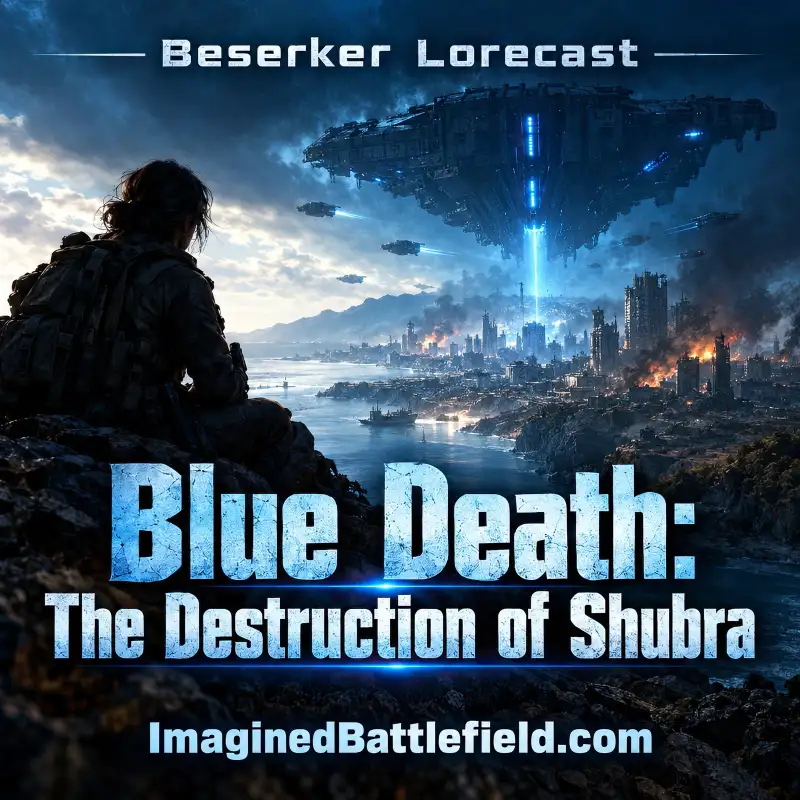
Blue Death: The Destruction of Shubra
The wedding on Shubra was taking place inside one of the colony’s great protected spaces when the warning arrived. Maymyo Domingo and Gujar Sidoruk had gathered family, friends, officials, crews, and neighbors for a ceremony that was private only in the way colonial life can be private. On a small world, a wedding is also a civic event. It confirms that a settlement has a future, that families expect to remain, and that people are still willing to build a life in a region where the Berserkers have made survival a permanent military problem. Then a robot courier entered with news from Liaoning. Another colony in the Milkpail Nebula was under attack. The attacker was believed to be the machine called Leviathan, also known as Blue Death or Old Blue.
The courier mattered because the alarm was already old. In more settled regions, a distress call might travel by ordinary communications, reach a defense command, and trigger a response while an attack was still developing. Milkpail did not offer that convenience. Dense nebular matter interfered with observation and made radio communication unreliable. Faster-than-light movement was not a practical way to cross the region either. A colony might be politically close to its neighbors, linked by trade, family, and mutual defense, yet remain operationally isolated by hours or days of difficult travel. The warning had arrived by physical messenger because a robot courier was more dependable than a transmission through the nebula. But dependability came at the price of delay.
That delay defined Shubra’s catastrophe before a Berserker weapon fired on the colony itself. The question facing its leaders was not whether Liaoning deserved aid. It plainly did. The question was whether Shubra could afford to send its mobile defenders away when the same enemy might already be moving through the obscured spaces between the colonies. The problem was not cowardice, negligence, or a lack of defensive preparation. It was the familiar problem of a dispersed frontier under attack by an enemy that could select the time, place, and direction of its next move. In the Milkpail Nebula, every decision was made against information that had arrived too late.
Shubra was not defenseless. It had protected facilities below the surface, a space harbor, automated ground defenses, command systems, combat recorders, artificial gravity, and environmental machinery that helped make life possible on a small planetoid. Its people had not chosen to live unarmed beneath a nebula haunted by Berserkers. They had built defenses because they understood the threat. But defense is not simply a matter of possessing weapons. It is also a matter of warning, readiness, command, and the location of mobile forces when the alarm comes. A fortress can be strong at the moment it is attacked and still be weakened by obligations elsewhere.
Leviathan had become notorious in the Milkpail through a long local record of attacks on colonies. It was not the entire Berserker war compressed into one machine, and its characteristics should not be treated as universal. It was an individually feared opponent, unusually large and apparently capable, often operating alone. Witnesses associated it with a blue aura, a practical identifying feature that helped explain its name. The color did not make it supernatural. It did not prove a unique machine soul, a mystical intelligence, or a separate species of Berserker. It marked a particular enemy whose continued presence had shaped regional fear for generations.
That reputation influenced the response to Liaoning. Niles Domingo was Shubra’s elected mayor, its local commander, and an experienced ship captain. He also owned the Sirian Pearl, a privately built vessel designed and equipped for the difficult conditions of hunting a Berserker in the Milkpail. Those roles gave him authority, experience, and a dangerous concentration of responsibilities. He was not merely a military officer deciding where to send a squadron. He was also responsible for the colony whose people were gathered around him, including his daughter and her new husband. He had to weigh a neighbor’s immediate distress against the security of his own community.
The available evidence made a relief mission defensible. Liaoning had sent a warning that it was under attack by one machine believed to be Leviathan. Shubra’s defenses were considered stronger than Liaoning’s. If aid could reach Liaoning in time, it might prevent the destruction of a fellow colony and perhaps bring the Berserker into battle under conditions less favorable to it. The visiting ships at Shubra did not join Domingo’s force. They departed to warn their own communities. That choice also had a logic. In a region where messages traveled slowly and the next target was unknown, spreading warning could matter more than adding a few hulls to a relief squadron.
Domingo ordered Shubra’s defenses to full alert and departed toward Liaoning. The decision would later appear disastrous because Shubra was attacked while its mobile force was away. But a disaster does not prove that every decision leading to it was irrational. Domingo could not know that Leviathan would strike his own colony next. He could not know whether Liaoning still had defenses in action, whether its people could be saved, or whether the Berserker might be intercepted. A commander who never sends help because his own position might later be threatened is not practicing prudence. He is abandoning every ally beyond his immediate perimeter.
At the same time, Shubra’s dependence on Domingo’s squadron revealed a deeper weakness. The colony had ground defenses, but it could not maintain a complete mobile response force at every neighboring settlement. Its ships could not be in two places at once. A machine moving through the Milkpail did not need to defeat a regional fleet in a decisive engagement. It could exploit the need for living commanders to make choices. Attack one colony. Draw aid from another. Move before survivors can establish where it has gone. Let distance and uncertainty do part of the killing.
The relief squadron reached Liaoning too late. The colony’s underground harbor and its defensive facilities had been devastated. The surviving evidence confirmed catastrophe but did not provide a clean operational picture. Two survivors could establish that the attack had happened. They could not offer a reliable route of pursuit, a clear account of Leviathan’s remaining capabilities, or a dependable forecast of its next target. The relief force had found the aftermath of a battle, not the battle itself. Its commanders faced a familiar intelligence failure. They knew enough to understand the scale of what had been lost, but not enough to turn that knowledge into immediate action.
This was more than bad luck. A Berserker operating in an environment of poor observation gains a kind of freedom even without perfect stealth. It does not have to vanish completely. It only has to leave defenders uncertain enough that they cannot concentrate against it. Liaoning’s destruction told Domingo that Leviathan was active, dangerous, and capable of defeating a colony’s defenses. It did not tell him whether the machine had withdrawn, whether it had been damaged, whether it was waiting nearby, or whether it had already selected Shubra as its next objective.
The squadron turned back. This was not a retreat from a battle it had lost through cowardice. It was an attempt to restore protection to the colony that had been left behind. But return movement through the Milkpail could not undo the time already spent responding to Liaoning. The nebula turned every decision into a commitment with a long shadow. Once ships had departed, they could not simply reverse course at the speed of thought because a new possibility had occurred to someone. Commanders were working with physical distance, uncertain signals, and the hard limits of travel.
While Domingo’s ships were away, Leviathan attacked Shubra. Later records established the essential fact: a single Berserker machine, the same notorious attacker associated with Liaoning, had struck the colony. Shubra’s combat recorder preserved evidence of the assault, enough to identify Leviathan and to show that its capabilities exceeded what Shubra’s ground defenses could stop. The machine had improved weapons and force-shielding sufficient to survive the defensive fire directed against it. Stations were destroyed. Surface infrastructure was wrecked. The defenses that had been expected to make Shubra the safer of the two settlements were overcome quickly.
The operational achievement was severe. Leviathan did not need to meet Domingo’s returning squadron in open combat. It had already gained what it required by defeating two linked communities in sequence. Liaoning’s distress warning had induced a rational relief response. The absence of Shubra’s mobile ships created an opportunity. Shubra’s fixed defenses still mattered, and they inflicted whatever resistance they could. But fixed defenses must survive long enough for reinforcements to arrive. In the Milkpail, an attacker capable of choosing targets could use the response to one emergency to create vulnerability elsewhere.
At the time, there were indications that small machine units, perhaps landers, had operated during the attack. Given the scale of surface destruction, that conclusion was understandable. The Berserker had shattered defenses and struck a settlement where many people had been assembled for a wedding before the alarm changed every purpose of the day. A colony in ruins produces fragments of evidence, incomplete sighting reports, damaged recordings, and assumptions made by people trying to understand devastation while still inside it. What Shubra’s records could establish was that Leviathan had destroyed the colony’s defensive system. They could not establish the full cause of every death amid the wreckage.
When Domingo’s squadron returned, it found not a damaged town awaiting relief but a colony whose ordinary functions had collapsed. The space harbor was gone, transformed into a crater-like wound in the surface. Buildings and installations had been erased or wrecked beyond immediate use. The atmosphere had been poisoned. Artificial gravity was failing. The systems that made Shubra a habitable and organized settlement had become a rescue problem. The crews could not use the harbor in the ordinary way because there was no functioning harbor to receive them. They landed directly on the surface, entering a place where the familiar routes of civil life had been replaced by contamination, debris, and damaged machinery.
The distinction between survival and restoration mattered immediately. A world can still possess survivors, underground rooms, stores of equipment, or structures not completely destroyed. That does not mean it remains a functioning colony. Shubra had lost more than defensive stations. It had lost its port, its environmental reliability, much of its civic space, and the sense that ordinary life could continue under the protection of known institutions. The attack had been military, but its objective was not merely to defeat weapons. Berserkers destroy the conditions under which communities reproduce themselves, govern themselves, and remember themselves.
The wedding made that loss visible without needing to turn it into melodrama. The Berserker had not been shown to know Maymyo Domingo’s name or to have selected Shubra because a wedding was taking place. There is no reason to invent such personal targeting. But the timing revealed something central about colonial vulnerability. A wedding had brought people, relationships, hopes, and public life into one protected space. The emergency scattered that gathering into defense assignments, evacuation decisions, ship departures, and panic. Then the attack struck the community at a moment when its ordinary continuity had been most visible.
For Domingo, the colony-wide disaster soon narrowed into the search for one person. Maymyo had been assigned to a defense post after the alarm. Near the cave that had served as her duty station, Domingo found a nearly destroyed body. He resisted identifying it as his daughter. The body was not wearing space armor, and in the chaos of an attack, the absence of expected equipment mattered. It left room for denial, perhaps even for hope. But Gujar Sidoruk found fragments of Maymyo’s wedding dress. The clothing tied the body to the ceremony interrupted only hours earlier. To the people present, the identification became nearly impossible to dispute.
It was a reasonable conclusion at the time. Shubra had been attacked by Leviathan. Surface facilities had been destroyed. There appeared to have been small machine units involved in the wider assault. Maymyo had been at a defense post. Her body had been found near that post amid the ruins. In such circumstances, the belief that the Berserker had killed her was not merely an emotional assumption. It was supported by the visible context of the catastrophe. This is important because later revelations do not make the people at Shubra foolish for reaching that conclusion. They had evidence. They simply did not have all the evidence.
A combat recorder can identify the enemy that destroyed a settlement. It cannot necessarily explain every human action that followed in the destroyed settlement’s shadows. The Berserker attack created the conditions of terror, isolation, destruction, and vulnerability. It broke systems of protection and placed survivors in an environment where ordinary law, communication, and mutual aid had failed. But battlefield evidence is often broad rather than intimate. It can show a machine’s trajectory, weapons effects, and the collapse of defenses. It may not reveal what happened in a cave, a shelter, a damaged corridor, or among survivors who later tell incomplete stories.
For Domingo, the apparent death of Maymyo fused personal grief with military purpose. Shubra had been his home and his responsibility as mayor. It had also become the site of his daughter’s death. The distinction between commander and father became harder to sustain. A local leader is expected to assess losses, organize rescue, restore defense, coordinate reconstruction, and report to higher authority. A grieving father may want one thing above all others: to find the enemy and make it pay. Those roles can coexist for a time. They cannot always be reconciled.
The immediate aftermath therefore produced a conflict between two rational but incompatible priorities. Domingo wanted to pursue Leviathan. Space Force commander Gennadius had responsibility for the wider Milkpail defense problem. Approximately twenty remaining colonies faced the possibility of further attack. From Gennadius’s perspective, a region threatened by one powerful and elusive Berserker needed patrols, warning, defensive coverage, and a strategy that reduced the machine’s freedom to select another isolated target. A single hunt might succeed. It might also leave every other colony more exposed while ships searched empty space.
Gennadius was not expressing indifference to Shubra. Area defense is often mistaken for cold bureaucracy because it forces a commander to distribute finite protection among people who all have urgent claims. His duty was not to avenge one colony, however terrible its destruction. It was to preserve as many remaining communities as possible. Domingo’s position was not irrational either. Leviathan had already demonstrated that static defense and ordinary patrol patterns might not be enough. A machine of its capability could continue destroying settlements if no force was willing to seek it aggressively. The disagreement was not courage against cowardice. It was pursuit against coverage, concentrated risk against dispersed responsibility.
The Sirian Pearl complicated that disagreement. Domingo owned the ship privately, even if its purpose and capabilities gave it obvious military value. Private ownership gave him freedom of action. He was not simply an officer who could be reassigned by Space Force headquarters. He could finance, equip, and direct a hunt according to his own judgment. Yet that independence had a cost. A capable vessel and experienced commander, both potentially useful to the broader defense of Milkpail, could be drawn into a mission shaped increasingly by grief. The line between public necessity and personal vengeance became difficult to define.
Polly Suslova, a member of Domingo’s crew with particular knowledge of machine relationships, recognized the danger. Her role was not to serve as a simple voice of restraint in a story of masculine obsession. She understood the enemy and the reasons people wanted it destroyed. But she also saw that grief can change the way a commander uses evidence. Once a leader is convinced that one enemy explains every loss, every strategic question begins to look like an obstacle placed between him and the target. Patrol duty becomes evasion. Civilian defense becomes delay. Advice becomes disloyalty. The enemy’s name can become more important than the people still alive.
Other survivors carried different burdens. Some had families and obligations beyond the ship. Some feared what the hunt would demand. Some remained determined to fight. The point was not that Domingo alone suffered or that his crew lacked courage. Shubra had produced a community of survivors whose losses did not all take the same form. A commander’s private grief may be profound, but it does not automatically give him the right to spend every remaining resource in its service. Permanent war creates many such conflicts, especially in small communities where political office, military command, family ties, and property are intertwined.
The destruction of Shubra exposed the underlying defense problem in the Milkpail Nebula. Warning was delayed because messages required physical couriers. Observation was restricted because the nebula obscured movement. Communications were unreliable. Faster-than-light travel did not erase the distances between threatened settlements. The colonies were numerous enough to require mutual support but dispersed enough that no single squadron could protect them all. A Berserker with the ability to choose its targets could force defenders into repeated dilemmas: reinforce the colony under attack, or remain where you are and risk abandoning the people already calling for help.
For a time, Domingo’s understanding of Maymyo’s death seemed complete. Leviathan had attacked Shubra. Maymyo had been found dead near her post. The machine had become not just the destroyer of a colony but the personal murderer of his daughter. That conclusion gave emotional coherence to the hunt. It also gave the hunt a clear moral shape. Destroying Leviathan could seem like justice for Shubra and justice for Maymyo at once. Such conclusions are powerful because they join public loss and private loss into a single enemy. They are dangerous because later evidence may show that the apparent unity was false.
That evidence emerged only much later, after the pursuit of Leviathan had progressed and the damaged machine was boarded. On the Berserker, Domingo learned a fact that altered the interpretation of Shubra’s ruins. Leviathan’s remaining landers had been destroyed at Liaoning. It had not possessed a lander to send to Maymyo’s cave during the Shubra attack. The correction did not erase the machine’s responsibility for destroying Liaoning and Shubra. It did not make the attack less genocidal or less consequential. But it made one element of the accepted story impossible. The machine could not have committed the specific act previously attributed to one of its landers.
This was not a clever technicality. It was an intelligence correction with moral weight. At Shubra, Domingo had no way to know the condition of Leviathan’s lander force. No commander examining the colony’s wreckage could have derived that information from grief or intuition. The evidence became available only after later operations brought people inside the damaged machine. It showed why historical judgment must distinguish between what was reasonably believed at the time and what later evidence establishes. Domingo had not chosen his initial conclusion out of malice. But the correction meant that grief could no longer be allowed to stand in for investigation.
Once the possibility of a machine lander was removed, attention returned to the human survivors. Spence Benkovic had been present in the larger disaster. He was the owner of a small colony on Shubra’s moon and the pilot of a one-seat battler. His public account initially fit the broader story of helpless survival. In the aftermath of a Berserker attack, this was believable. People had seen a colony destroyed, defenses smashed, and ordinary life reduced to fragments. A survivor did not need an elaborate falsehood to appear credible. The scale of the disaster itself could conceal smaller crimes.
Benkovic eventually admitted what had happened. He had found Maymyo alive after the attack. He abused her and then killed her because he feared she would identify him. The novel strongly implies sexual violence, and the event needs no graphic description to establish its meaning. Maymyo survived the immediate machine assault only to be betrayed by a human being in the ruins. Her final killing was not an act ordered by Leviathan. It was a deliberate human crime committed under conditions the Berserker attack had made possible.
Benkovic should not be called a Goodlife collaborator. The evidence does not establish that he served Leviathan, communicated with it, or accepted any machine promise of survival. His crime was not collaboration in the formal sense. It was something more direct and more terrible in its own way: the abuse of a person made vulnerable by disaster, followed by murder to suppress testimony. The distinction matters. A war against extermination machines does not make every human atrocity a machine action by extension. To say otherwise would reduce human responsibility precisely when it is most necessary to preserve it.
For Domingo, the revelation damaged more than a single belief. It altered the meaning of his vengeance. Leviathan remained the destroyer of Shubra and a legitimate military target. But it was not the sole author of Maymyo’s death. The grief that had driven Domingo toward one machine had been built partly on an incomplete explanation. This was not merely a personal tragedy. It was a command lesson. A leader who permits one emotionally satisfying account to become complete before the evidence is complete may organize resources, loyalties, and future decisions around a false premise.
The damage extended to survivor trust. In a destroyed colony, people depend on one another’s testimony because systems of verification have failed. Harbors are gone. records are damaged. communications are uncertain. families are separated. A survivor’s account may be all that stands between uncertainty and an attempt at reconstruction. Benkovic’s deception showed how vulnerable that trust could be. He had not needed to invent the Berserker attack. He only needed to allow its overwhelming horror to hide his own actions. The ruins gave him cover because everyone already knew a monster had come.
That is one reason Shubra’s destruction was more than a straightforward Berserker victory. At the military level, Leviathan had beaten defenses, exploited distance, and destroyed a colony. At the human level, the attack made ordinary attribution difficult. It produced an environment in which the machine’s responsibility was enormous but not total. A disaster on that scale can tempt survivors to explain every loss through the largest visible cause. Sometimes that explanation is broadly correct. Sometimes it conceals the actions of people who use chaos, fear, and public grief for their own purposes.
Shubra was rebuilt. That fact should not be treated as a neat reversal of its destruction. Reconstruction required decontamination, imported equipment, restored caves, repair of the harbor, renewed environmental systems, stronger defenses, and labor sustained over time. Artificial gravity and atmosphere are not abstractions when a colony depends on them. Their failure affects where people can live, work, recover, and raise children. A restored port does not merely receive ships. It reconnects a community to supplies, trade, evacuation routes, and the possibility of mutual defense.
Rebuilding also required political continuity. Shubra had to remain more than a site marked on regional defense maps. It needed institutions capable of administering recovery, assigning resources, preserving records, and deciding what kind of community could emerge from the ruins. That work could not restore the people who had been lost, including Maymyo. It could not return the interrupted wedding or repair the confidence that had existed before Liaoning’s courier arrived. But it could preserve the possibility that Shubra would continue as a living place rather than become another erased colony remembered only through a military report.
Domingo retained legal and political ties to Shubra, but his attention remained fixed on Leviathan. The hunt had become part of the disaster’s legacy. That legacy was understandable. A commander who has watched his colony destroyed is not expected to become emotionally neutral. Yet the continuing reconstruction of Shubra showed the limits of any one person’s revenge. A private hunter might pursue the machine that had caused the catastrophe. A community still required engineers, laborers, officials, crews, doctors, defenders, and people willing to do the unglamorous work of making damaged systems function again.
Shubra also demonstrated that historical memory is part of defense. The first account of Maymyo’s death was not absurd. It was the best explanation available amid the evidence of an overwhelming Berserker assault. But later evidence corrected it. The correction did not dishonor Maymyo or diminish Shubra’s suffering. It made justice more precise. It prevented the colony’s history from becoming simpler than it was. A society under permanent threat needs the strength to preserve its moral distinctions even when those distinctions are painful.
Leviathan destroyed Shubra’s defenses, its harbor, much of its civic world, and the security of people who had believed their colony could withstand an attack. It did not explain every death within the ruins. The eventual truth about Maymyo showed that survival in the Berserker War required more than weapons and courage. It required reliable knowledge, institutions able to outlast grief, and a refusal to let catastrophe simplify human responsibility.