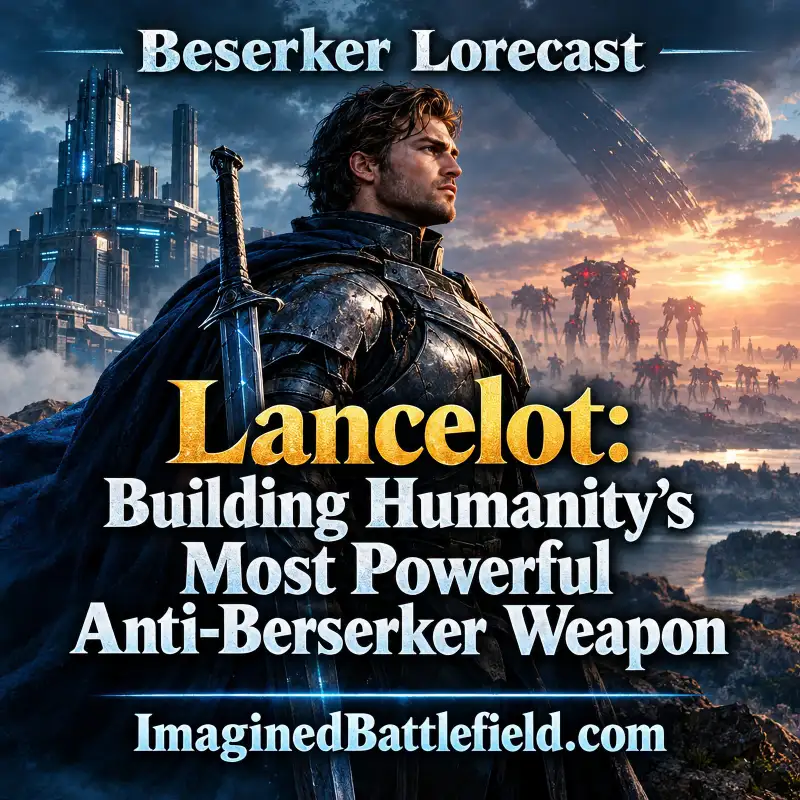
Lancelot: Building Humanity’s Most Powerful Anti-Berserker Weapon
Moonbase did not receive Michel Geulincx as it would have received an ordinary recruit. He was eleven years old. He had come from Alpine, a colonial world where his life had appeared to be taking a far more peaceful direction. His adoptive parents knew him as an unusually gifted boy, especially in art. The opportunity offered to him carried the respectable shape of an art-school scholarship. It was also a route into military custody. By the time Michel understood that much, Solarian authorities had brought him into a secret program built around Lancelot.
That decision reveals the central problem before Lancelot has done anything in combat. The Solarian military had not discovered a rifle that any trained soldier could carry, a ship that any crew could operate, or a new fleet doctrine that could be distributed through established commands. It had found, or believed it had found, a weapon system that required a particular child. Michel was not simply assigned to Lancelot. His mind, body, history, and unusual capacities appeared to be part of the conditions under which Lancelot could become what it was intended to be.
A civilization at war with Berserkers could make a serious case for taking extraordinary risks. These were not enemies seeking territory, tribute, or surrender terms. Berserker machines existed to destroy life. They could operate across immense distances, endure conditions fatal to biological crews, and adjust their methods when a colony, fleet, or government found a successful defense. Against that threat, the pressure to find a decisive advantage was real. It was not invented by a frightened bureaucracy looking for a new project.
But necessity does not settle the question of ownership. If one child is essential to a weapon, is that child a volunteer, a protected national asset, a patient undergoing transformation, a military dependent, or simply property in more polite language? Berserker Man never permits Lancelot to become a clean answer to that question. Its power is impressive precisely because its human cost and human dependence cannot be separated from its military promise.
The larger war explains why Solarian planners would pursue such a dangerous possibility. Earth-descended civilization was dispersed across many worlds and systems. It relied on colonies, transport routes, technical centers, military facilities, and imperfect lines of communication. A fleet could defend an important region. A shipyard could replace losses over time. A base could train personnel and preserve accumulated knowledge. None of those institutions could guarantee that a Berserker would not reach a remote population first, infiltrate a vulnerable system, or exploit a delay between warning and reinforcement.
That was the strategic environment in which Lancelot mattered. It offered the prospect of local overmatch. A human being equipped through this system might meet a machine threat with capabilities beyond those available to ordinary personnel. That prospect did not mean fleets had become obsolete. It did not mean a single operator could patrol all of civilization. It meant that, at a critical point, a living defender might be able to act where conventional forces could not arrive in time or could not act effectively enough.
There is an old temptation in military history to describe a new weapon by listing its specifications. Range, armor, speed, power, and destructive capacity all have their place when the evidence exists. Lancelot resists that treatment. The novel demonstrates effects without providing a neat engineering manual. It shows force-field structures, unusual movement, enhanced awareness, and a relationship between operator and system that goes far beyond the control of an ordinary machine. Those demonstrations are more important than imaginary measurements.
Lancelot is not a standard combat suit. It is not merely a vehicle wrapped around a pilot. It is not an autonomous artificial intelligence sent to fight in place of human beings. And it is not a captured Berserker redirected toward a better cause. Its strength comes from an intimate union of technological capacity and human operation. The language of melding or merger is useful as shorthand, provided it is not mistaken for a complete technical explanation. Something profound happens when Lancelot and a compatible operator work together, but the text leaves important mechanics and boundaries uncertain.
That uncertainty matters because Lancelot's purpose differs fundamentally from that of the Berserkers. The ancient death machines are organized around a closed objective, the destruction of life. Their intelligence can be flexible in method while remaining fixed in ultimate purpose. Lancelot does not replace human judgment with such a directive. Its operation remains bound to a living person who can fear, choose, misunderstand, care, and refuse. That does not make the system harmless. It makes its danger different. Lancelot's risk lies in dependence, transformation, and control, not in a built-in mission of extermination.
The first practical question was whether this relationship could be standardized. Frank Marcus provides part of the answer. Marcus was an experienced Solarian pilot, a man whose survival through repeated Berserker encounters had already marked him as unusual. At Moonbase, he could use Lancelot in training or evaluation. His performance showed that the system was not locked, in the simplest possible sense, to Michel alone. A skilled adult with the right qualities could enter into a meaningful operational relationship with it.
On the lunar surface, Marcus demonstrated the kind of mobility and protection Lancelot could offer. The force-field structures associated with the system allowed movement and action that ordinary personnel could not reproduce. The significance was functional, not theatrical. A human operator could act with speed, agility, and resilience that changed the terms of immediate contact with a machine threat. Lancelot might turn an exposed individual into a force capable of surviving and intervening in an environment where ordinary troops would be outmatched.
Yet Marcus's success did not solve the problem of replaceability. He was a veteran, not evidence of an assembly line. His ability to use Lancelot did not prove that he and Michel possessed the same compatibility, underwent the same transformation, or could reach the same potential. A military organization can build doctrine around a weapon only when it understands who can operate it, how operators are trained, what happens when they are injured, and how losses can be replaced. Lancelot answered none of those questions cheaply.
The distinction is easy to miss because military language tends to flatten people into categories. Pilot, operator, specialist, asset, casualty replacement. Those terms are useful for organizing a force. They become dangerous when the weapon's essential component is a human personality. Marcus established that Lancelot could be used by more than one person. Michel established that the system's deepest potential may have depended on qualities command did not fully understand and could not simply manufacture.
That is why Michel's artistic gifts are not decorative background. In another kind of story, the artistic child would exist to symbolize innocence before war intrudes. Here, his creativity becomes part of the military problem. The Solarians are not interested in art merely as a talent to be protected. They are interested in a form of perception and cognition that may connect to Lancelot in ways conventional military selection cannot measure. The project suggests that imagination, pattern recognition, identity, and embodied awareness may matter as much as discipline or technical skill.
That insight is strategically useful and ethically unsettling. If Michel's gifts make him uniquely valuable, they also make him more vulnerable to institutional appropriation. The state can say that it needs him. His protectors can say that he is safer under military control. Scientists can say that further testing is essential. Commanders can say that delay risks whole worlds. Each claim may contain truth. None of them automatically tells Michel what he is allowed to want.
His age sharpens every question. An eleven-year-old cannot be treated as a veteran volunteer simply because he performs under extraordinary conditions. Training, secrecy, physical transformation, and separation from family all carry different weight when imposed upon a child. The military necessity in Berserker Man is not trivial, and the people around Michel are not reducible to uncomplicated villains. They are trying to resist an enemy that threatens every living society. Still, the project exposes what permanent existential war can do to moral language. Protection and possession begin to sound uncomfortably alike.
Michel's adoption and uncertain family history also become strategically relevant. That is another sign that the program cannot remain inside a laboratory. A conventional weapon can be inventoried, transported, guarded, and tested. Michel cannot. He has parents, memories, fears, loyalties, and questions about where he came from. Any effort to make him into a purely military instrument must either answer those questions or try to suppress them. Neither approach can be stable for long.
Secretary Tupolev represents the institutional side of the gamble. His strategy does not simply call for a larger fleet meeting the Berserkers in a conventional decisive battle. Instead, it concentrates expectation around Michel and Lancelot. That is a rational response to a problem fleets cannot solve by mass alone. An adaptive enemy may present a threat in a place, time, or form where a specialized capability matters more than broad numerical strength. A commander who ignores that possibility is not being cautious. He may be refusing an available advantage.
At the same time, concentrated capability produces concentrated risk. Tupolev's decision requires secrecy, technical support, security arrangements, medical and scientific oversight, transport, and a chain of authority capable of moving an irreplaceable child through a war zone. It requires people to make decisions about Michel's life while possessing only partial information about the weapon they are developing. It also requires the rest of Solarian society to trust a project that, by its nature, cannot be widely explained.
This is a civil-military problem as much as a technical one. A government at war must decide who gets to authorize a program like Lancelot, who may assess its risks, and what safeguards apply to its operator. Military command needs the system to work. Technical personnel need time and access to understand it. Political authorities need results, but also bear responsibility for what is done in the name of collective survival. When the operator is an eleven-year-old child, secrecy becomes harder to defend as a neutral administrative detail.
The logistics are equally unforgiving. Michel must be trained, protected, moved, supplied, and kept out of enemy hands. Lancelot must be maintained and understood well enough to be deployed without destroying the very advantage it offers. The system cannot be casually risked in every skirmish because there is no evidence that the Solarians can replace it with a warehouse spare or a new class of graduates. This is the opposite of a mass-production solution. Its brilliance is tied to scarcity.
Scarcity limits strategy. Lancelot can create a tactical opportunity. It cannot be everywhere. It can make a person formidable. It cannot cultivate food on a threatened colony, crew every defensive ship, reconstruct a destroyed shipyard, or provide a political order for frightened worlds. The Solarian war effort still depends on institutions that can train people, build ships, maintain communication, preserve knowledge, and care for civilians. A unique weapon may save those institutions in a crisis. It cannot become a substitute for them.
The move from Moonbase toward military proving grounds in the Uranian system makes this clear. The program is leaving the protected ambiguity of early testing and entering a phase where its capabilities must be made operational. Proving grounds are useful because they allow controlled evaluation. Personnel can observe performance, identify failures, and build procedures around an unfamiliar system. But proving grounds also create exposure. Repeated use establishes patterns. Security measures reveal what command considers important. A system that must be tested may also be studied by the enemy.
This is a familiar dilemma in weapons development, even if Lancelot itself is anything but familiar. Concealment preserves surprise but prevents learning. Testing produces knowledge but risks detection. Deployment proves utility but exposes the operator to loss. The stakes are magnified because the operator is not interchangeable. Michel cannot be treated like expendable test hardware, yet the military cannot learn to use Lancelot without placing him in conditions that carry real danger.
The Uranian setting therefore matters less as scenery than as a measure of transition. Lancelot is no longer only an experiment on Moonbase. It is becoming an asset whose protection, movement, and employment must be planned in relation to enemy pursuit. The system may let Michel confront dangers that would overwhelm ordinary personnel. It also makes him a target whose capture or destruction would be a major loss. Greater power has not reduced vulnerability. It has concentrated it.
As the story develops, the explanation for Michel's significance becomes more disturbing. The possibility emerges that the Berserkers engineered aspects of his conception. This is not information that Solarian command possesses at the beginning of the project. It arrives as a revelation and an interpretation within a wider investigation of Michel, the machines, and the mystery drawing both sides onward. That sequence is essential. The military thinks it has identified a rare human resource. It later confronts the possibility that the enemy may have shaped conditions surrounding that resource.
This is not the same as saying Michel was a machine from birth, half machine, or secretly a Berserker agent. Those phrases are too simple and too false to the problem the novel presents. Michel remains a living human being, with relationships, perceptions, and choices that cannot be reduced to an enemy design. The more troubling point is that an extermination system may have attempted to manipulate human biology and family history in order to create an instrument useful to its own inquiry.
If that interpretation is correct, it represents a form of infiltration more profound than disguise or sabotage. A human-looking infiltrator can be detected, in principle, through procedure, observation, and technical examination. Manipulation of conception and origin attacks the assumptions behind those procedures. It forces Solarian authorities to ask whether the very person they believe they control has been placed in their hands by an enemy plan. That question destabilizes trust without supplying an easy answer.
It also creates a danger for Michel himself. Once his origins are connected to Berserker design, others may be tempted to treat him as an enemy product. That would repeat the machines' own error. A living being is not defined forever by the intentions of those who brought him into existence. Michel's importance lies partly in his capacity to become more than anyone's instrument, whether that instrument is a Solarian military project, a collaborator's Savior, or a Berserker experiment.
The revelation changes the intelligence picture. Before it, Lancelot appears to be a secret human achievement built around an exceptional child. After it, the project must consider the possibility that human achievement and machine manipulation have intersected in ways no one fully understands. That does not invalidate the Solarian effort. It does mean that the effort cannot assume it owns the entire chain of causation. In war, the most dangerous surprises often come from believing that one understands the origin of an advantage.
Lancelot becomes crucial in this larger problem because it is itself difficult to classify. It is neither an ordinary human nor an autonomous machine in the simple sense. It is a human-machine relationship that produces new capacities without erasing the human being at its center. Michel's connection to it carries creativity, vulnerability, and uncertainty into a domain where the Berserkers seek fixed answers. The system's power is not just that it can survive a fight. It can enter a problem the enemy's categories may not fully contain.
That does not make ambiguity a magic weapon. The Taj is not a convenient cosmic answer to the entire Berserker War. Michel does not destroy all Berserkers, and Lancelot does not become a universal solution distributed to every threatened world. The unresolved quality of the later movement is part of the novel's point. A civilization fighting extermination cannot expect every decisive matter to yield to a clean technical explanation. Sometimes the most important thing learned is the boundary of what command can know.
For that reason, Lancelot should not be understood as a mirror image of the Berserkers. It is technologically formidable, but it is not a death machine whose value rests on removing human agency from the chain of action. Its power comes from making human agency more consequential. Michel's perceptions matter. His attachments matter. His uncertainty matters. His capacity to choose what he will become matters. Those qualities make him difficult to manage, which is exactly why they distinguish Lancelot from an extermination system.
There is no comfortable resolution in that distinction. Human-machine integration can increase a person's capability while placing that person under immense institutional pressure. It can make defense possible while exposing identity to manipulation. It can protect life while forcing a civilization to ask whether it is sacrificing the freedom it claims to defend. Berserker Man does not answer those questions with a slogan about technology being good in human hands. Human hands are not simple. They can protect, exploit, hesitate, and change.
Lancelot succeeds because it does not eliminate the human element from war. It makes that element more consequential than ever. Humanity's most powerful anti-Berserker weapon is therefore not a machine that can operate without people, but a system whose strength depends on one young person's capacity to remain more than the purpose others designed for him.