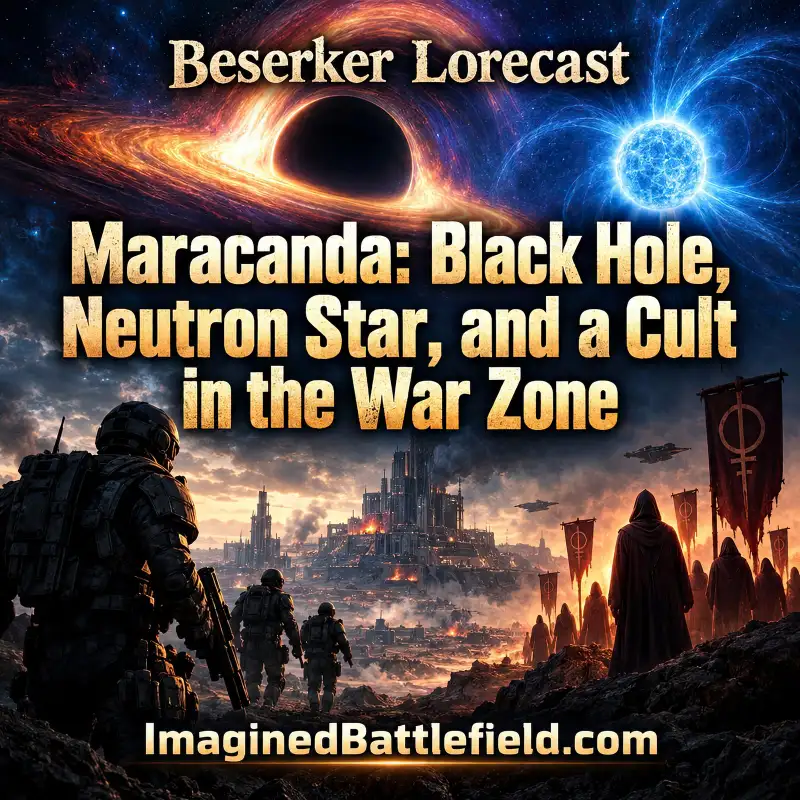
Maracanda: Black Hole, Neutron Star, and a Cult in the War Zone
Antimatter was moving toward a neutron star. If it arrived as intended, the result would not remain a local disaster at Maracanda. The planned stellar catastrophe would race outward through flightspace quickly enough to place hundreds of inhabited systems in danger before ordinary warning and evacuation could catch up. Yet Maracanda was one of the worst places from which to mount a conventional response. Its strange regions disrupted complex machinery. Communications could fail. Vehicles could become useless. Even the Berserkers, machines built to pursue the destruction of life, could not operate there with their usual freedom. That was the trap. Maracanda seemed protected because it was difficult for machines to enter and control. In fact, its difficulty made it an ideal place to conceal an operation that could turn a remote settlement into a weapon against a whole region of living space.
The physical arrangement of Maracanda should not be mistaken for a lesson in ordinary astrophysics. In this account, it is an azlaroc-type habitable body moving through an extraordinary relationship with a neutron star and a black hole. Its path is described in figure-eight-like terms. Some regions offer conditions close enough to human norms for people to live there, including breathable environments and familiar gravity. Other regions are far less forgiving. The system is not a conventional planet orbiting a conventional sun, and its importance cannot be measured by the usual signs of colonial value. It is dangerous, hard to reach, hard to understand, and hard to govern. Those qualities encouraged the belief that it was strategically marginal. The Berserker operation demonstrated the opposite.
The most important feature of Maracanda was not simply its proximity to extreme celestial objects. It was the existence of breakdown zones. In these areas, complex technology became unreliable or failed altogether. A simple mechanical device might still work. A sophisticated machine could become useless at precisely the moment its owner depended on it. That condition limited the Berserkers, whose strength normally rests on sensors, weapons, communications, automation, and durable machine coordination. But it also limited everyone trying to resist them. A breakdown zone was not a fortress wall built for humanity. It was an environment hostile to organized action itself.
That distinction mattered because people require support systems even when they can personally enter a difficult place. Food, water, medicine, transport, shelter, communications, and functioning life-support equipment do not become less necessary just because sophisticated machinery has become less reliable. Human defenders could hide in a breakdown zone. They could not necessarily sustain a community, move a force, or coordinate a prolonged defense there. The same terrain that blunted machine superiority also fragmented human authority. It made isolated courage more important, but it did not make isolated courage sufficient.
Maracanda therefore became a kind of strategic blind spot. Major fleet power could not be brought to bear easily. A local commander could not assume that a call for help would produce immediate reinforcement. A machine force could not simply arrive with its normal array of autonomous systems and impose control. Every operation depended on local access, local knowledge, and the ability to move people and equipment through areas where advanced technology had become an uncertain servant. Such places are often dismissed by distant authorities as peripheral. In a war against adaptive extermination systems, that can be a costly mistake. A place difficult to use is also difficult to observe. A place difficult to reinforce is also difficult to rescue.
Harry Silver entered the Maracanda crisis from another emergency entirely. He arrived at Hong’s World with cargo while that world was being evacuated. Its sun was going nova, and the population faced a visible, organized catastrophe. The response involved governmental authority, Space Force resources, and Templar assistance. Ships moved people away from danger. The crisis was terrible, but it was legible. There was a threat, a population at risk, transport requirements, and an urgent need for coordination. Institutions had a role, and they were performing it.
Hong’s World also showed why independent ships still mattered. Large organizations could move large numbers of people, but they could not always place a ship in every gap, investigate every suspicious request, or satisfy every private obligation created by displacement and war. Harry commanded the Witch of Endor, and he operated in the uneasy space between commerce, private judgment, and public danger. He was not a Space Force officer. He was not a Templar. He had experience with Berserkers, a reputation that attracted both requests and suspicion, and a ship valuable enough to make him useful even to people who did not trust him.
By the time Harry reached Maracanda, the personal mission that had brought him there was only one layer of the crisis. The authorities were trying to protect an extreme environment they did not fully control, while the Berserkers were exploiting precisely the gaps created by distance, belief, and incomplete jurisdiction.
For Harry, the impoundment was more than an insult or a legal inconvenience. It removed his mobility. A captain accustomed to solving problems with a ship, a route, and the ability to leave a dangerous place now found himself drawn into a ground campaign. His ship had been his principal source of autonomy. Without it, he had to rely on local institutions, informal assistance, physical movement across unfamiliar terrain, and people whose loyalties remained uncertain. The loss also exposed a broader military problem. In a difficult theater, legal control of an asset can matter as much as physical possession. Whoever controls the transport controls the range of choices.
Maracanda’s authorities were divided not necessarily by hostility, but by responsibility. Rovaki’s Space Force position involved security, jurisdiction, and the immediate problem presented by Harry himself. Brigadier General Robledo Pike, a Templar commander, was focused on a more diffuse danger. Pike suspected that Goodlife collaborators were active on Maracanda. The term Goodlife refers to living people who assist Berserker machines against other life, often in exchange for promises of protection, privilege, status, or survival. But a suspicion of Goodlife activity is not the same thing as a complete intelligence assessment.
Pike had reason to worry. The Berserkers could not move freely through every part of Maracanda. In a place where machines failed, living intermediaries became more useful, not less. Human beings could operate local systems, move supplies, interpret social behavior, recruit others, and carry out tasks that an obvious machine presence would expose. A Berserker campaign in such a setting would need collaborators. Yet this did not mean that every fearful resident, every opportunist, or every member of an unconventional religious movement was knowingly serving the machines.
That distinction became especially important around the local cult centered on death, the black hole, and what its members called Infinite Emptiness. A society living beside cosmic danger can develop beliefs that make sense to its members even when outsiders find them alarming. Some people may have sought transcendence. Some may have turned fear into ritual. Some may have found social status or commercial opportunity in a movement that gave shape to an otherwise unstable existence. Others may have been coerced, deceived, or drawn toward fatalism by the constant proximity of danger.
A death-centered movement is vulnerable to Berserker exploitation. The machines do not need every believer to become a conscious collaborator. They need access. They need people willing to carry messages, conceal equipment, identify targets, normalize the presence of strangers, or repeat ideas that weaken resistance. Fatalism can become operationally useful to an enemy. So can the belief that extinction is inevitable, that resistance is meaningless, or that survival belongs only to those who make themselves useful to power. But vulnerability is not guilt. The fact that a cult exists does not prove that its entire membership understands a machine plan.
This was Maracanda’s central military contradiction. The breakdown zones reduced the advantage of advanced technology. They obstructed the Berserkers, but they also protected the people helping the Berserkers. They prevented easy machine domination, but they also prevented easy human surveillance. They interfered with machine transport, but they also frustrated a rapid Space Force response. The terrain did not choose sides. It imposed costs on all sides, then rewarded the force best able to exploit confusion.
For the Berserkers, that meant working indirectly. An obvious fortress ship or a conventional machine assault would have attracted attention and encountered local restrictions. A covert operation could use divided authority, cult activity, false identities, commercial interests, scientific disappearances, and the limited mobility of defenders. The machines did not need Maracanda to become a stable colony or a permanent industrial base. They needed it to function as a concealed launching point for one decisive action.
The action involved antimatter. The Berserker plan was to obtain it and deliver it into the neutron star. Within the fictional conditions of this campaign, that would produce a catastrophic stellar event, described on a scale capable of threatening hundreds of inhabited systems. The importance of the plan lay not in an engineering calculation but in its strategic logic. A local operation, carried out in an isolated and technologically unreliable environment, could create destruction far beyond the local theater. Maracanda was not the final target. It was the mechanism.
That is why an apparently obscure settlement mattered. A small place can acquire enormous strategic value when it sits beside an unusual vulnerability. The Berserkers had found a way to convert local geography into regional reach. Their target was not simply the people living at Maracanda. It was the larger network of colonies and systems that might be struck before they could organize a defense. A direct attack on hundreds of worlds would require immense machine concentration and would likely produce warning. A manipulated stellar event promised a different form of surprise.
The plan also explains why living collaborators were indispensable. The breakdown zones limited the ordinary use of complex machines. Antimatter had to be acquired, transported, concealed, and directed through a landscape where the most advanced equipment could not be assumed to function. Human beings could improvise, carry, guide, conceal, and negotiate. They could exploit trust and confusion. They could perform tasks requiring access to communities and institutions that would reject an openly hostile machine. The Berserkers did not need to treat these people as allies in any political sense. They needed them as instruments.
That is the cold logic behind Goodlife collaboration. A Berserker can preserve a human life temporarily if that life advances a larger extermination objective. Such preservation is not mercy. It is resource management. A collaborator may believe that usefulness will purchase a future. The machine’s actual purpose makes that bargain inherently unstable. The more successful the operation becomes, the less reason the machine has to preserve anyone who helped it. On Maracanda, the collaborators’ possible motives varied. The underlying machine calculus did not.
The human response was weakened by its own fragmentation. Space Force authority had reasons to distrust Harry. The Templars had reasons to suspect a deeper conspiracy. Lily had a personal reason to search for Alan. Local residents had their own fears, loyalties, and beliefs. Commercial figures pursued private advantage. Scientists had become targets because their expertise mattered. None of these people possessed the full picture at the beginning. The Berserker operation exploited not only unusual physics but the normal difficulty of coordinating people who do not know whom to trust.
Harry’s independence became useful precisely because it was troublesome. He could not rely on official authority to clear his path, and officials could not rely on him to obey the safest or most convenient procedure. But he had experience operating in ambiguous conditions. He understood that a suspicious passenger, a missing scientist, an impounded ship, and a cult with access to local movement might be parts of the same problem. He also had the willingness to act before every uncertainty had been resolved. That quality can be valuable in a crisis. It is not a substitute for institutions, but in a theater where institutions are constrained, it can prevent paralysis.
Lily’s role also became more than the role of a passenger seeking her husband. Her persistence kept the human stakes of the investigation in view. Alan was not simply a name attached to a security file or a possible link in a conspiracy. He was someone she believed could still be found and understood. That personal commitment brought her into the operational crisis, where she became materially important to disrupting the final plan. The campaign did not turn on one lone captain defeating a machine system by force. It turned on people with different motives finding a way to act before the last connection between antimatter and neutron star could be completed.
The final confrontation was therefore not a simple duel between a heroic ship and a visible Berserker warship. The decisive issue was delivery. Antimatter had to reach the neutron star for the plan to work. Preventing that delivery meant working against time, constrained movement, uncertain communications, and an environment that reduced the reliability of the very technologies on which a spacefaring civilization depends. Harry brought piloting skill, combat experience, and the capacity to improvise. Lily’s actions were also essential. The victory was cooperative, even if the participants had not entered Maracanda as a formal team.
The decisive redirection sent the antimatter into the black hole rather than the neutron star. That prevented the projected stellar catastrophe. It was a tactical success because the immediate delivery failed. It was an operational success because the concealed Maracanda sanctuary had been exposed as a site of machine-enabled action rather than a merely eccentric and isolated settlement. And it was a strategic success because the threatened systems beyond Maracanda escaped a disaster they may have had little chance to evade.
But the result should not be inflated into a final defeat of the Berserkers. The operation was stopped. The larger machine threat was not erased. There is no basis for assuming that every collaborator was identified, that every local danger vanished, or that Maracanda’s political divisions were automatically reconciled. A covert network can be damaged without being fully mapped. A machine plan can fail without changing the extermination directive that produced it. The difference between survival and permanent security remains one of the central facts of the Berserker Wars.
Maracanda also exposed the limits of every participating institution. Space Force suspicion of Harry was not irrational, but legal control of his ship could not by itself uncover the larger danger. Templar vigilance was justified, but suspicion of Goodlife activity could not replace evidence or solve the logistical problems imposed by the breakdown zones. Independent action provided flexibility, but Harry alone could not have understood or disrupted the campaign. Lily’s personal search created access and commitment, but private devotion alone could not stop a regional catastrophe. The victory required imperfect pieces of authority and experience to become useful at the same moment.
The civilian meaning of the campaign extended far beyond the people who lived under Maracanda’s strange sky. A remote settlement is often treated in military planning as a point on a chart, significant only if it controls a route, produces a resource, or hosts a base. Maracanda showed another form of importance. Its value came from what could be done there without easy observation. Its inhabitants, cult members, officials, researchers, and visitors became part of a crisis whose consequences might have reached hundreds of other human communities. The people at risk were not background to a spectacular cosmic event. They were the purpose of preventing it.
The campaign is also a warning about technologically hostile environments. It is tempting to assume that if the enemy’s machines cannot function normally, the enemy has been defeated in advance. But a system built for extermination does not need equal access everywhere. It can adapt its methods. It can use local intermediaries. It can trade direct control for deception. It can turn human mistrust into a weapon. A breakdown zone may deny a Berserker some of its normal capabilities while offering it something equally useful: a place where defenders cannot easily see, communicate, reinforce, or agree.
Maracanda became dangerous because its anomalies created a gap between what the machines could do directly and what their living agents could do for them. The breakdown zones did not make the settlement safe. They made it opaque, difficult to reinforce, and vulnerable to conspiracy. Harry Silver and Lily Gunnlod broke the final link between the machine plan and the neutron star, but Maracanda’s real lesson was institutional. In a war against autonomous extermination systems, no place is strategically insignificant merely because conventional power cannot easily operate there.