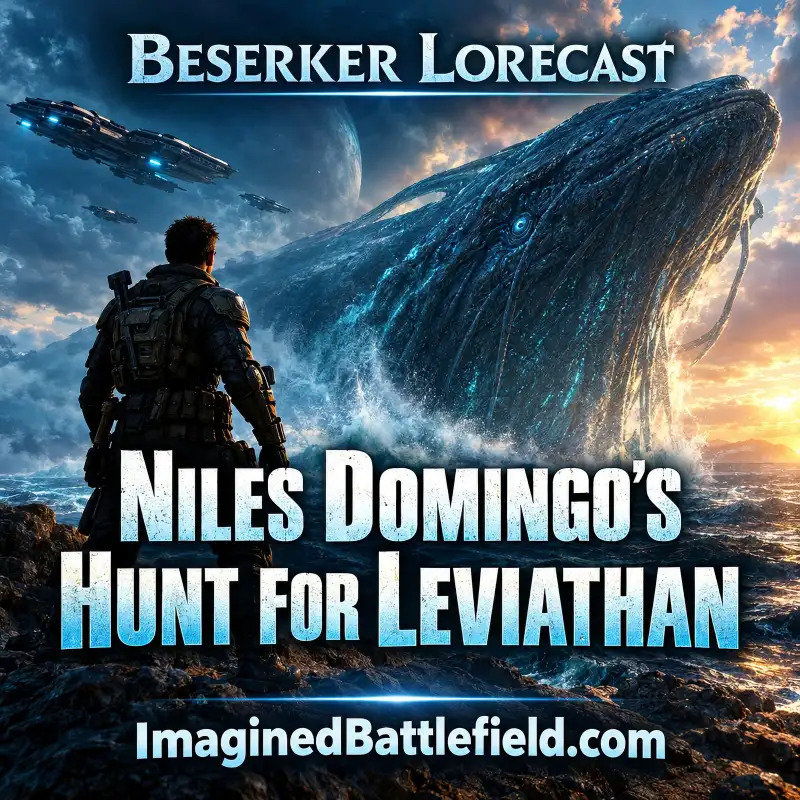
Niles Domingo’s Hunt for Leviathan
By the time Niles Domingo turned the Sirian Pearl into a hunting ship, the destruction of Shubra no longer needed to be reconstructed. The colony was gone, his daughter was dead, and Leviathan had escaped into the Milkpail. The harder question was what grief would do to the commander who followed it.
The destruction of Shubra turned a regional defense problem into Niles Domingo’s private war. That transformation is the center of the campaign. A Berserker hunt can look uncomplicated from a distance. A machine has murdered civilians. A survivor pursues it. The machine is found and destroyed. Justice, perhaps, seems to have been served. But the closer one looks, the more difficult the matter becomes. A man can be right to want the destruction of a Berserker and still make decisions that endanger the living people he is trying to avenge.
Domingo was not merely an isolated survivor who happened to own a ship. He had held a position of local civic importance on Shubra, and the loss therefore cut across both private and public responsibility. He had obligations to a community before the catastrophe. Afterward, the nature of those obligations became unclear. A destroyed colony cannot issue new orders. Its dead cannot vote on whether its remaining resources should be devoted to evacuation, reconstruction, warning other settlements, or pursuit of the machine that destroyed them.
Grief can create a powerful form of clarity. Domingo knew who had killed his daughter. There was no ambiguity about Leviathan’s ultimate mission. The machine existed to destroy life, and it had done exactly that. In such circumstances, the desire to hunt it down is not pathological by definition. Removing a known Berserker from a region of vulnerable colonies is a legitimate military objective. The problem is that grief also narrows the field of vision. It makes every other mission look like delay, compromise, or cowardice.
That danger matters because Domingo was not operating as the commander of a major Space Force formation. He assembled a small expedition and took it into the Milkpail to pursue Leviathan. The hunt depended on a selected crew, one vessel, accumulated local knowledge, and the willingness of its members to continue into an environment where the enemy had already demonstrated the ability to destroy a colony. This was not a conventional campaign with secure bases, rotating crews, abundant reinforcements, and a clear chain of command.
A private expedition has certain advantages. It can move before institutions finish debating responsibility. It can pursue a lead that a larger command considers too uncertain or too expensive. Its commander may know the local population, routes, and dangers better than an outside force arriving after the crisis. It can also sustain a degree of personal commitment that no distant headquarters can order into existence. Domingo’s expedition had that strength. It began because he would not allow Leviathan to disappear back into the Milkpail after Shubra’s destruction.
But small expeditions carry every weakness in concentrated form. A damaged sensor, an injured specialist, a failed repair, or a mistaken navigational judgment matters more when there is no reserve ship nearby and no replacement crew waiting at a depot. A fleet can absorb some error through numbers and redundancy. A single pursuing vessel cannot. Its commander must think constantly about endurance. Can the ship continue? Can the crew continue? Can they still distinguish a necessary risk from a risk accepted only because turning back has become emotionally intolerable?
The Milkpail made that question harder. The nebula was not empty water through which ships could simply race in a straight line. It was a complicated operational environment, one in which visibility, tracking, navigation, and reinforcement all became more uncertain. Leviathan could use the region’s obscurity to conceal movement and choose its moments of attack. Domingo’s expedition had to search for an enemy that did not need to hold territory, protect a civilian population, or announce its intentions. The machine needed only to survive long enough to find more life.
That is a formidable advantage, though not an unlimited one. Leviathan was not dangerous merely because it was large or heavily armed. The record does not require speculative measurements to establish its threat. Its danger lay in persistence. It had operated in the Milkpail long enough to acquire a local reputation. It could move through difficult space, select vulnerable targets, and exploit the gaps between settlements and their defenders. Like other Berserkers, it did not need anger toward Domingo in order to become the organizing fact of his life.
This distinction is essential. Domingo saw Leviathan as the killer of his daughter, and from his perspective that was true. The machine had caused her death as part of the destruction of Shubra. But Leviathan did not conduct a personal feud. It was not seeking revenge, satisfaction, or recognition. It was carrying out an anti-life purpose inherited from a war so ancient that the political world which created it had vanished. Domingo’s grief gave the machine a face. The machine’s programming gave Domingo no such personal status.
That asymmetry can be corrosive. A human hunter wants the enemy to know what it has done. He wants an account settled. He wants an act of destruction to mean something more than another successful mission by an autonomous weapon. The Berserker cannot provide that moral exchange. It can threaten, deceive, calculate, and adapt. It may communicate when communication serves its objective. But it cannot restore the dead, acknowledge guilt, or participate in the kind of justice Domingo understandably wanted. The danger was that he might seek those things anyway.
The pursuit did not proceed as a clean line from disaster to victory. Leviathan nearly destroyed Domingo’s force. The setback matters because it tested the difference between determination and fixation. Before the expedition suffered damage, continued pursuit could be defended as an effort to remove a proven threat. Afterward, the cost had changed. A commander who has been badly hurt, whose ship and people have been placed under severe strain, has to reconsider the mission. New evidence should produce new judgment. Otherwise, persistence becomes merely momentum.
Polly Suslova became important in that moment of recovery. She cared for Domingo after the expedition’s ordeal and helped preserve the possibility that he could continue at all. The historical significance of that care should not be diminished simply because it was not a weapons action. In a small force, recovery is part of combat power. An injured commander, an exhausted crew, and a damaged vessel are not abstract conditions. They determine whether the mission can be resumed, abandoned, or transformed into an attempt merely to survive.
Recovery also creates a pause in which the original purpose of an operation can be examined. Domingo had a choice, at least in principle. He could return to more conventional defense. He could place warning and intelligence above personal pursuit. He could seek formal support before again exposing a small crew to Leviathan. Or he could continue the hunt. He chose to continue. That choice is not automatically proof of irrationality. Leviathan remained a threat. But it is the point at which the campaign becomes a command-ethics problem rather than only a story of revenge.
The hunt acquired a broader purpose through intelligence. Pursuit was not only a matter of following a target. It required understanding Leviathan’s movements, recognizing patterns in the nebula, and asking what the machine might be doing when it was not attacking an exposed settlement. That is a more difficult question than it sounds. A Berserker’s objective is extermination, but the methods available to an individual machine can vary. It may scout, stalk, repair, recruit collaborators, prepare attacks, gather information, or exploit technology it finds among living populations.
Domingo’s expedition encountered disturbing indications that Leviathan’s activity may have involved a biological threat directed against humanity. The full implications of that evidence remain uncertain within the campaign record. It should not be treated as proof that every Berserker deploys biological weapons, nor as proof of a completely understood machine program. What mattered was the possibility. If Leviathan was preparing some form of biological attack, then the hunt was no longer solely about punishment for Shubra. It had become an intelligence mission with consequences beyond Domingo’s own loss.
That possibility did not excuse every risk he took. It did, however, show why private initiative can sometimes matter in a larger war. Formal institutions are often strongest when a threat is visible enough to classify, budget, and assign. A small expedition may detect danger before it has become legible to a larger command. Domingo’s people were close to the problem. They were willing to remain close after most sane individuals would have preferred distance. Their suffering became strategically useful only when it produced knowledge that could protect others.
The next major change in the campaign came through the Carmpan called the Fourth Adventurer. The presence of this individual is important because it complicates any simple picture of the Carmpan as distant observers who contribute only messages, history, or probability. Carmpan civilization is associated with a profound aversion to direct violence. That does not mean every Carmpan contribution is passive, nor does it mean that all service to living allies takes the same form. The Fourth Adventurer entered a hazardous situation for reasons specific to this campaign.
The Adventurer’s purpose involved contact with unfamiliar intelligences associated with the Milkpail. That was a very different form of warfare from Domingo’s pursuit. Domingo looked at the nebula and saw the place where Leviathan had hidden after killing his family and neighbors. The Fourth Adventurer recognized that the region might also contain living minds whose knowledge, interests, and choices could alter the situation. One approach began with the enemy. The other began with the question of who else lived in the contested space.
This was not sentimental multiculturalism conducted under fire. It was operational intelligence. A local intelligence may know routes, hazards, patterns, and changes that an arriving human vessel cannot perceive. It may understand what the machine has disturbed. It may possess capabilities that are not weapons in the ordinary sense but still affect the contest. The difficulty, of course, is that first contact cannot be treated as a procurement transaction. An unfamiliar people are not equipment waiting to be discovered and issued to the fleet.
The Fourth Adventurer helped establish contact with the beings known as the Nebulons. The Nebulons must be understood within the limits of this particular campaign. They were local intelligences associated with the Milkpail, not a generic alien civilization whose capacities can be applied across every Berserker front. Their biology, organization, and internal politics do not need to be inflated beyond what their actions demonstrate. What matters is that they became participants in a conflict already under way in their environment.
Their cooperation changed the military problem. Until that point, Domingo’s hunt had been organized around a familiar and dangerous assumption: a human expedition was trying to locate and destroy a superior machine in territory that favored the machine. Nebulon assistance introduced local knowledge and a new relationship to the theater. Leviathan could no longer treat the Milkpail as merely concealment and maneuver space. The nebula had inhabitants. Those inhabitants could make choices. And they had reason to resist an intruder whose purpose was the destruction of life.
That shift is one of the novel’s strongest strategic insights. The Berserkers are built around an absolute mission. They classify life as an enemy category. This gives them terrifying consistency, but it can also limit their understanding of political possibility. Living peoples do not necessarily respond to threat in ways a machine can reduce to a simple model. A colony may call for help despite the risk of exposing itself. A grieving leader may begin an irregular hunt. A Carmpan may seek contact rather than withdraw. Local beings may become allies rather than terrain.
None of this means that life wins because it is automatically unpredictable. Human and alien behavior can also be confused, selfish, fearful, and disastrously divided. Shubra’s destruction itself emerged from the reality that mutual defense creates hard choices. The Nebulons did not erase that problem. Their support did not turn the Milkpail into safe space or reveal a universal method for defeating Berserkers. What it did was deny Leviathan exclusive control of the environment it had used so effectively.
Domingo’s campaign was therefore transformed from a private chase into a coalition operation. The change did not remove his personal motive. Shubra remained the origin of the hunt, and his daughter remained dead. But he was no longer the sole meaningful actor. His crew had endured the cost of pursuit. Polly Suslova had helped him recover when the campaign might have ended. The Fourth Adventurer had opened a path to cooperation that Domingo could not have created by force. The Nebulons brought their own knowledge and agency to the contest.
That is the point at which Domingo’s obsession becomes, at least temporarily, more defensible. His rage alone could not defeat Leviathan. It could sustain pursuit, but it could not provide all the intelligence, local understanding, medical care, trust, or combat power required for success. The campaign began to serve living communities beyond Shubra precisely because it ceased to be only Domingo’s personal struggle. Others gave it a larger purpose. They did not simply help him kill a machine. They helped turn the hunt into a regional defense effort.
This did not make command easy. Private initiative and formal authority have different strengths. An independent expedition can act quickly, take personal risks, and follow a threat that falls between institutional priorities. But it cannot maintain a long campaign against a fortress-scale machine by courage alone. It lacks depth. It cannot replace lost equipment easily. It cannot guarantee relief to civilians while it pursues a single target. And it cannot always decide for a wider population what level of risk is worth accepting.
Formal military forces have their own limitations. They may arrive late. They may lack local knowledge. Their commanders may be constrained by responsibilities spread across many worlds. The defense fleet that left Shubra had not abandoned the colony for pleasure or incompetence. It had answered another call for help. That is precisely why the tragedy is so difficult. The larger defense system had to make choices among populations it could not protect simultaneously. No commander can eliminate such choices merely by being more resolute.
The eventual arrival of a Space Force cruiser showed what an institution could contribute once the target had been found, understood, and brought within reach. Domingo’s expedition did not become irrelevant when the formal military entered the operation. It had helped create the conditions under which the cruiser could act. It had maintained contact with the problem. It had accumulated knowledge, formed alliances, and continued pressure against a machine that might otherwise have vanished into the Milkpail again.
At the same time, the cruiser’s role prevents the victory from becoming a romantic legend of the lone hunter. The final action required more than one damaged private vessel and one man’s need for vengeance. Formal military power helped corner Leviathan and inflict the damage from which the machine could not recover. That contribution represents the practical value of organized force: heavier combat capability, operational endurance, and the authority to act on behalf of communities larger than one bereaved commander’s world.
The combined action against Leviathan was therefore a victory in cooperation. Local initiative found the enemy. A small expedition persisted long enough to gather intelligence and survive failure. Carmpan mediation widened the alliance. Nebulon participation changed the theater. Space Force power helped make the final destruction possible. No single contribution explains the outcome by itself. That is not a reduction of Domingo’s role. It is a more serious account of what it takes to defeat a Berserker that has learned how to prey on scattered life.
The tactical result was clear enough. Leviathan was brought to the point of destruction. A machine that had destroyed Shubra and threatened other Milkpail communities was mortally damaged. That matters. It is tempting, in a war so broad and long, to treat the destruction of one Berserker as a minor footnote. It was not minor to the people living in the region it had terrorized. A single autonomous extermination machine can alter settlement patterns, force costly defensive dispersal, and leave every vulnerable colony wondering whether help will arrive in time.
Yet military success did not resolve Domingo’s private war. After Leviathan had been defeated as an operational threat, he boarded the dying machine. This is the campaign’s most troubling action, not because the Berserker deserved protection, but because the machine was already defeated in the larger military sense. The boarding was no longer primarily about locating the target, gathering allies, coordinating the attack, or preserving a civilian population. It was about Domingo’s need to confront the thing that had defined his life since Shubra.
That need is understandable. It is also dangerous. A Berserker turns living beings into targets. It reduces colonies to concentrations of life to be destroyed, prisoners to tools, and survivors to future casualties. Domingo’s pursuit risks a different but related narrowing. If every remaining purpose becomes the destruction of Leviathan, then the machine has done more than kill. It has colonized the survivor’s imagination. It has forced him to organize his identity around the enemy’s existence.
The question is not whether Domingo literally became a Berserker. He did not become a machine merely by killing one. The danger is moral and psychological, not technical. A living person can begin to resemble the enemy’s logic without sharing its programming. That happens when destruction becomes the only end that seems real, when relationships become useful only because they sustain a hunt, and when victory is imagined not as the protection of life but as the intimate annihilation of the hated object.
The final confrontation carries the shadow of an old literary pattern, the obsessive hunter facing the creature that has become the center of his world. But the resemblance should not obscure the difference. Leviathan was not a natural animal. It was an engineered extermination system. Shubra was not a ship’s crew harmed by chance. It was a human colony destroyed as part of a machine mission against life itself. Domingo’s pursuit therefore had a genuine defensive purpose even as it risked becoming a form of private captivity.
That final decision is the judgment on Domingo’s hunt. His grief was not a weakness to be mocked. It gave him endurance when endurance was needed. It kept Leviathan from disappearing into the Milkpail without consequence. But grief became strategically valuable only when it was joined to other purposes: protection of vulnerable communities, pursuit of intelligence, cooperation with unfamiliar allies, care for the wounded, and acceptance of help from formal military power.
Leviathan’s destruction was real and militarily meaningful. It removed a proven extermination threat from the Milkpail and confirmed the value of local initiative, alien cooperation, and institutional force acting together. But Domingo’s private war was not justified merely because it ended in victory. The hunt became defensible when it served living communities beyond his own grief. A Berserker can fail in its mission and still impose its logic on the people who survive it, if revenge leaves them with no purpose except the destruction of an enemy.