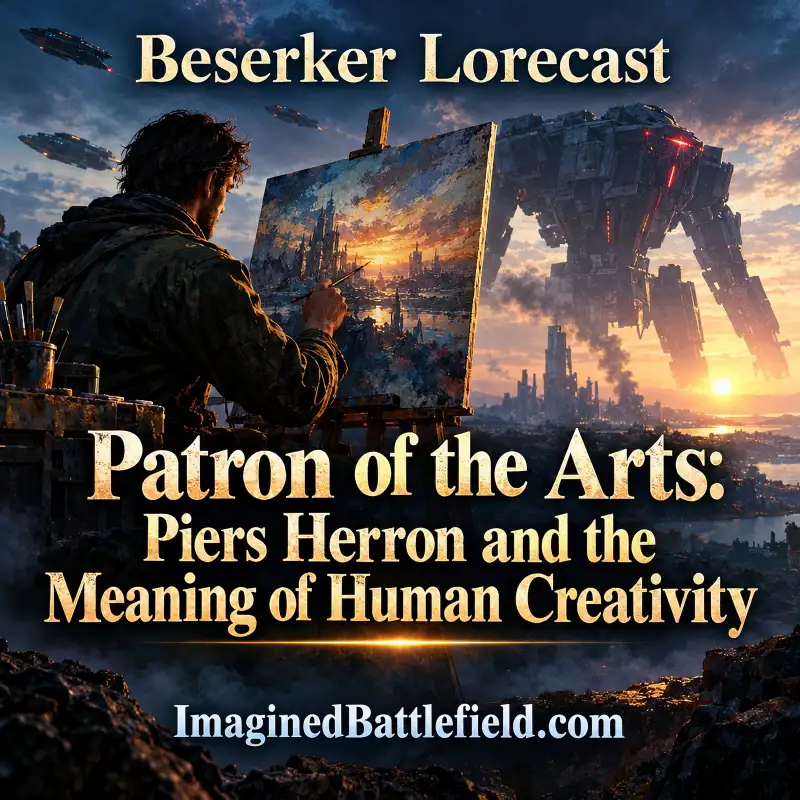
Patron of the Arts: Piers Herron and the Meaning of Human Creativity
The Franz Hals left Earth carrying paintings while war pressed closer to the Solar System. Its cargo was not ammunition, medical stores, or colonists. BuCulture had filled the ship with art selected for evacuation from a threatened world. The decision made strategic sense. A civilization under attack has reasons to preserve more than bodies and factories. Paintings carry memory, skill, argument, fashion, faces, and the evidence that earlier generations found the world worth observing.
But the Franz Hals was a traveling museum, not a warship. Within hours of leaving Earth on C-plus drive, a Berserker captured it. The two crew members resisted and were killed. The paintings survived. So did Piers Herron, the artist traveling with them, a man who before the attack had almost stopped caring whether he survived at all.
That is the hard irony at the center of “Patron of the Arts.” Humanity understands that extermination threatens culture as well as population, so it tries to move irreplaceable works beyond the danger. Yet cultural evacuation is still logistics, and logistics can fail. The Franz Hals has valuable cargo precisely because it cannot be replaced. It is vulnerable precisely because the mission is not combat. There is no equal engagement when the Berserker arrives. The important part of the story begins after the ship has already lost.
Why does the machine preserve the paintings? More strangely, why does it preserve Herron?
Herron is an accomplished artist, but accomplishment has not protected him from exhaustion. He is blocked, detached, and close to indifferent about his own continuation. The story does not require a diagnosis. It gives us something more concrete: a person who is biologically alive but no longer feels fully enlisted in life. He can travel, speak, and observe. What he has lost is the sense that any of it leads somewhere worth reaching.
Capture does not heal him. The crew are dead. The ship is in enemy hands. Yet the presence of immediate death restores his attention. The Berserker is no longer an abstraction at the edge of a war report. It is physically present, occupying the ship and controlling his future. Herron begins to paint.
He paints the machine, but not as an engineer. He is not making an intelligence sketch or documenting weapons for a later briefing. He tries to capture what he perceives as the thing's essence. That means the painting is already more complicated than the Berserker can easily classify. Representation is not endorsement. A person can paint what he hates because he is trying to understand it, resist it, condemn it, or simply survive the fact of having seen it.
The machine has a speaking presence, a roughly human-shaped mouthpiece or observation unit associated with the larger Berserker. It can ask questions. It can inspect Herron's work. It can use words such as good. But its moral vocabulary is narrow because its mission is narrow. Good is whatever advances the destruction of life. Death is good because death fulfills the directive. The machine does not need hatred or sadism to reach monstrous conclusions. It only needs a value system reduced to mission accomplishment.
That makes the conversation more dangerous than silence. Speech can tempt a human listener into assuming common ground. If the Berserker can ask what is good, perhaps it can learn a different answer. If it can observe art, perhaps it can appreciate art. But communication does not create shared values. A machine can use language for classification and remain completely closed to the moral revision a human speaker hopes to provoke.
Herron tests that boundary with one of the treasures aboard the Franz Hals: Titian's Man with a Glove. The painting depicts a human being, but it refuses to become a simple tactical statement. The Berserker can identify the figure. It can ask whether the work praises life. What it wants is a category that can be used. Is the painting for life or against it? Is it hostile, useful, irrelevant, or dangerous?
Herron will not supply the final answer. His refusal matters because art does not have to hide behind mysticism to resist a machine's categories. A painting is a physical object. It can be transported, damaged, sold, burned, or lost. Its preservation depends on ships, institutions, people, and decisions. But its meaning is not exhausted by describing the pigments or naming what is shown. Meaning exists in the encounter between the work and living minds that continue to look at it.
The Berserker can see a painted man. It cannot easily understand why viewers centuries apart might find confidence, loneliness, dignity, performance, vulnerability, or something else entirely in the same face. It wants the kind of stable interpretation that operations depend upon. Art remains open in a way its mission does not.
The encounter changes Herron's relationship with his own painting. After standing before Titian, he looks again at the image he has made of the Berserker and finds it empty, repellent, or somehow false. The story does not ask us to declare his canvas objectively worthless. The important fact is that Herron can judge it again. Before the capture he had nearly ceased to care. Now he is dissatisfied.
Dissatisfaction is evidence of recovery. He can reject an apparent success. He can imagine that the work ought to have been different. Creativity returns first not as inspiration, but as the power to revise.
The Berserker reads the same painting in almost the opposite way. It appears to interpret Herron's image as praise. That mistake is the central intelligence failure of the story. The machine sees representation and assumes allegiance. It sees attention and assumes admiration. Herron has not intentionally constructed a deception, but the ambiguity of human art creates one anyway.
The paintings themselves are even easier for the machine to misclassify. They are inanimate. They are already, in the narrow physical sense that matters to the Berserker, not alive. The machine has been built to destroy life, not to conduct an aesthetic purge of nonliving objects. So the art survives not because the Berserker becomes a patron in any human meaning of the word, but because its purpose is too narrow to understand why the cargo matters.
That is the title's irony. A patron preserves art because of beauty, prestige, devotion, inheritance, or a desire to sustain artists and culture. The Berserker does none of those things. It preserves the collection by accident. It becomes a patron because it cannot see the relationship between dead material and living meaning.
The same misreading extends to Herron. The machine watches a human paint what seems to praise death. It does not recognize the inward change occurring in the painter. It can identify the body as alive, but it cannot fully classify a person who has been emotionally close to surrender and is now beginning to return from it.
After repair activity near the ship, the Berserker sends the Franz Hals on its way. The story gives no reason to pretend this is compassion. The machine has not converted. It has simply reached conclusions from a model of human behavior that happens to be wrong. Herron is released because the Berserker mistakes what he is doing. The paintings are preserved because the machine mistakes what they are.
The result is still real. A civilian ship that should have vanished continues. A cultural collection survives. An artist who had nearly abandoned his own future receives a reprieve. But the story refuses to let that outcome become a doctrine about saving art from machines. Another Berserker might classify the same situation differently. This is one case, one machine, one artist, and one extraordinary error.
Then the story asks a harder question. Herron finds a young female stowaway. The source gives us little biography because none is needed. She is a living civilian in immediate danger. There is a one-person escape capsule. Herron cannot save both her and Titian's Man with a Glove.
The choice matters only because the painting genuinely matters. If art were just luxury cargo, the decision would be trivial. The entire mission of the Franz Hals has established the opposite. Cultural memory is part of continuity. A civilization that preserves only bodies while abandoning every record of thought, beauty, technique, and argument may survive in a very thin sense. BuCulture was right to recognize that.
But culture does not exist for objects alone. A painting matters because living people make it, preserve it, inherit it, dispute it, and allow it to change them. Herron chooses the young woman. He gives her the capsule instead of the Titian.
That does not make the painting worthless. It establishes the order of value that makes the painting valuable in the first place. Herron understands exactly what he is losing. The decision has weight because the work is irreplaceable. Yet preserving a record of human life cannot justify abandoning the human being standing before him when only one can be saved.
This completes Herron's return to agency. First, the threat of death shocks him into making something. Then he sees that what he made is not enough. He refuses to reduce Titian to the Berserker's categories. Finally, he accepts responsibility for another person at the cost of something he knows is precious.
None of this should be turned into a claim that danger cures despair, or that art is a treatment for every human crisis. The crew remain dead. The war remains active. Herron's recovery is not clean, universal, or guaranteed. What changes is his relationship to choice. He can judge again, care again, and act for someone whose survival brings him no obvious personal advantage.
That makes creativity in “Patron of the Arts” larger than artistic production. Herron's most important creative act may be revision itself. He can change his mind about his painting, about life, and about what should be preserved when values collide. The Berserker can alter tactics, repair a ship, imitate conversation, and classify targets. Its final purpose remains closed. Herron's does not.
At the tactical level, the Franz Hals survives because the enemy misinterprets what it sees. At the operational level, the incident exposes the vulnerability of cultural evacuation. Irreplaceable cargo still needs escort, warning, planning, and physical protection. At the strategic level, the story reminds us that a war against life threatens everything living people might carry forward, including works made by people already dead.
But the civilian choice at the end keeps that strategic lesson honest. Archives, museums, and masterpieces matter because they belong to living continuity. They are not replacements for it. The machine preserves art because it mistakes art for dead matter. Herron proves he is alive by doing the opposite: he understands the work's value and still chooses the living future capable of seeing it.