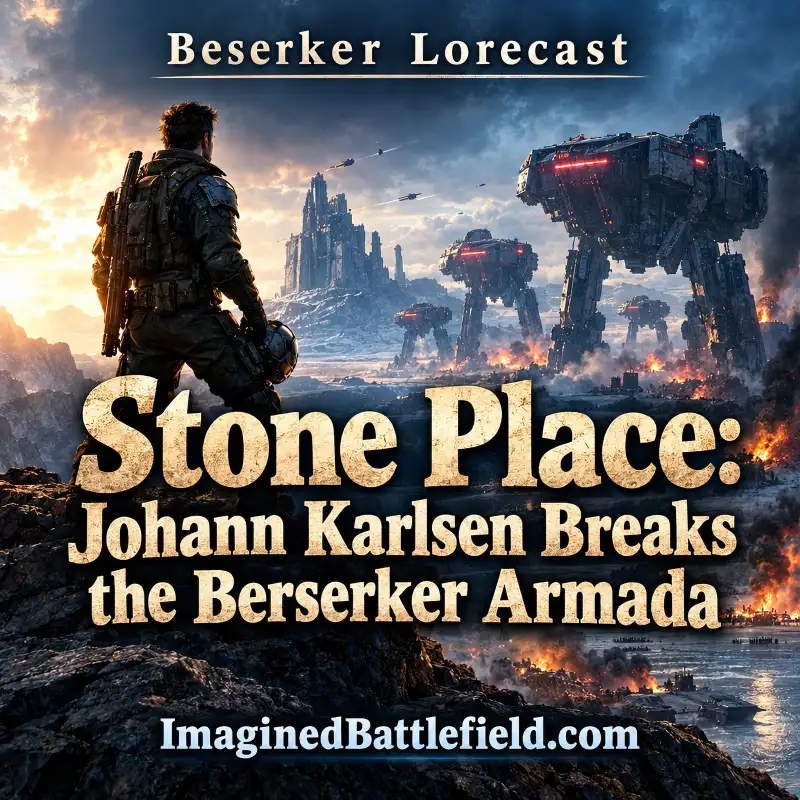
Stone Place: Johann Karlsen Breaks the Berserker Armada
The message from Atsog created the kind of crisis that can ruin a commander before the battle begins. The world was under Berserker attack. Among those likely trapped there was Christina de Dulcin, Johann Karlsen's intended bride. Karlsen had ships. He had crews demanding action. He had every personal reason to move at once. He also knew the fleet was not ready.
Its marines were still being distributed among suspicious allied crews. New tactics had not been tested in a major engagement. Political unity existed mostly because fear had made division temporarily unaffordable. A rush toward Atsog might satisfy every visible demand and still destroy the only force capable of stopping the concentrated Berserker offensive moving toward Sol. Karlsen waited.
That decision is where Stone Place truly begins. The famous battle that followed was not won because human beings were mysteriously unpredictable or because one gifted commander found a secret weakness in machine intelligence. Karlsen's advantage was more difficult to create. He preserved readiness when emotion demanded immediate action, forced rival human powers into a functioning coalition, and prepared a style of combat that accepted the Berserkers' strengths instead of pretending they did not exist.
The battlefield helped. Stone Place was a dark region between Atsog's Sun and Sol, dense with rock and debris and dangerous to cross through ordinary movement or C-plus travel. It was not a fortress and did not belong to either side. It was terrain in the oldest military sense, an obstacle that channeled movement and made timing matter. The commander who understood those limits could use them.
Karlsen held the title of High Commander of Sol's defense, but the title did not give him a single national fleet. Earth, Mars, Venus, Austeel, Esteel, and other interests contributed ships and people while retaining old suspicions. Karlsen himself embodied the political problem. He ruled Austeel and was half-brother to Felipe Nogara of Esteel. A successful commander tied to an existing ruling family could become a military savior, a political rival, or both.
Venus was indispensable. Admiral Kemal commanded a major part of the force, and Venerian ships could not simply be treated as equipment Karlsen owned. Their officers had their own traditions and their own concerns about Esteeler influence. The coalition possessed material strength before it possessed trust.
Karlsen's new doctrine made that weakness dangerous. He needed experienced boarding troops aboard vessels whose crews did not necessarily want outsiders there. The plan required ships to close with Berserkers, ram them when necessary, and put marines inside machine hulls. That meant cooperation at the level of stores, passageways, damage-control teams, medical spaces, and command authority. Political unity could not remain a speech delivered from the flagship. It had to survive inside individual ships.
The paintstick incident aboard Solar Spot showed how thin that unity was. An Esteeler marine took a paintstick from Venerian stores. The object was trivial. The reaction was not. A Venerian security officer turned a petty discipline problem into a confrontation over sovereignty and status. Under ordinary conditions, it might have ended in paperwork and resentment. In a fleet preparing to ram enemy machines, it threatened armed conflict among supposed allies.
This was Karlsen's real pre-battle problem. The Berserkers did not need to infiltrate every wardroom if human political memory could fracture the coalition by itself. Karlsen had to enforce discipline without confirming the fear that one faction intended to dominate the others. He had to make people accept shared risk before they trusted the people sharing it.
The Carmpan warning added another burden. A Prophet of Probability offered a forecast in which victory came with death, destruction, and failure. It was not a battle plan. It did not reveal a course, a target, or a schedule. Karlsen did not ignore it, but neither did he surrender command to it. Probability might describe the burden ahead. It could not decide whether marines were trained, ships were supplied, or the fleet was ready.
The Berserkers were adapting too. Earlier scattered attacks had met increasingly organized resistance. The machine response was concentration. Instead of sending another isolated threat, they assembled a major offensive force. Two strongly defended planets had already been destroyed. A concentrated armada moving toward Sol could do more than kill ships. It could shatter political confidence and destroy the human center before the coalition became stronger.
At Atsog, the machines gathered intelligence as aggressively as they used force. General Bradin was captured and killed during interrogation. Prisoners became sources. Fear became leverage. The Berserkers had also identified Karlsen as a serious command problem, not because he was impossible to model, but because he could make divided human forces act together. They called in reserves, including units long hidden or dormant.
Karlsen's staff counted two hundred forty-three human combat ships, one hundred of them Venerian. Six heavy vessels carried long-range C-plus cannon. The initial estimate put the Berserker force near two hundred ships. Even that apparent numerical balance was deceptive. Individual Berserkers could outperform ordinary human vessels in stand-off combat. If the battle became a conventional exchange of distant fire, the coalition would fight on machine terms.
Karlsen's answer was to change the geometry of the fight. The C-plus cannon could disrupt the enemy at range, but they were not the whole plan. Human ships would close, ram, and board. Marines would enter machine hulls, seize internal positions, free prisoners where possible, and attack vital systems from inside.
Ramming and boarding sound primitive only when the human cost is ignored. Ships had to survive collision long enough to remain usable. Engineers had to keep embedded hulls from becoming tombs. Medical teams had to work while compartments were damaged. Assault troops entered structures built for machine movement and machine defense, often without reliable maps. Karlsen's doctrine did not eliminate technological inferiority. It converted it into a close fight where human initiative might matter more.
Mitchell Spain understood what that meant. He was a Martian volunteer, a poet, and an experienced Berserker boarder, now commanding marines aboard the Venerian Solar Spot. His men were not decorations for the fleet's morale. They were the physical instrument of a strategy that required living people to enter the enemy. Then Atsog called for help.
Karlsen's refusal to move immediately was strategically sound and personally ruinous. If he committed before the fleet had finished integrating its boarding forces and command relationships, the Berserkers might destroy the coalition piecemeal. Waiting preserved the possibility of saving Sol. It did not make Atsog's civilians less real. Christina did not become an acceptable loss because a larger objective existed. Command sometimes means choosing which disaster can still be prevented, and no later victory cleans that choice of grief.
The fleet moved only after reconnaissance gave Karlsen enough information to act. Commander Hemphill led a four-ship scouting mission that located the enemy concentration. The report was useful, not perfect. It confirmed where the machines were and how urgent the situation had become. It did not identify every reserve or remove the fog around the enemy's final strength.
Karlsen attacked before the Berserkers could place themselves cleanly between his fleet and Sol. Stone Place shaped the approach. Both forces had to move around the dense region, and the human formation advanced in two leapfrogging lines while the heavy C-plus cannon ships followed more slowly. Then the estimate changed.
The human force had expected roughly two hundred machines. The visual count rose toward three hundred. The Berserkers spread for an envelopment, trying to use superior numbers and strong individual hulls to close around the human formation and destroy it in parts. Karlsen drove into the center.
The decision looked like an acceptance of the trap because, in one sense, it was. Karlsen's entire doctrine depended on denying the Berserkers a clean long-range battle. If the machine formation could be fractured at its hinge, the planned envelopment would collapse into a compressed engagement where broad coordination mattered less and close action mattered more.
The C-plus cannon opened the disruption. Their fire destroyed machines and forced reactions before the fleets fully closed. The guns did not win Stone Place. They made the ramming and boarding phase possible by damaging the formation Karlsen intended to penetrate.
Once the fleets came together, the battle lost the neatness of the approach. Communications became less reliable. Ships were damaged, displaced, or locked against enemy hulls. The earlier work of coalition-building became more important, not less. Karlsen could establish the plan and the purpose. He could not micromanage every breach after hundreds of ships entered close action.
The flagship itself rammed a Berserker. It was the planned transition from fleet maneuver to internal assault, and the risks arrived exactly as expected. Collision damaged both vessels. Human engineers had to preserve access. Marines had to hold their openings while machine defenders counterattacked through spaces they knew better.
Spain's people fought at the sally ports inside one captured machine. The enemy units were specialized combat systems, built for the environment and unconcerned with fear or pain. Spain's marines survived by using discipline and whatever the damaged interior gave them. A turret was restored. Searchlights exposed movement. Positions were held because troops understood the purpose even when the larger fleet picture had become impossible to see.
Spain was badly wounded and still fought long enough to destroy a heavily armored machine at close range. That action mattered, but not because one wounded marine officer won the battle. It mattered because it demonstrated that the doctrine worked where it was supposed to work. Human boarders could survive inside a Berserker long enough to deny the machine easy control.
This is also the better way to understand the often repeated idea of human unpredictability. Spain's men did not succeed by behaving irrationally. They trained, held positions, repaired equipment, protected one another, and adapted when the plan met reality. Their behavior was difficult to predict because it depended on local judgment, relationships, and purpose that survived even after the command picture broke apart.
Outside, the same process was unfolding at fleet scale. The Berserker center collapsed under concentrated attack. Some machines were destroyed. Others were captured, crippled, or wrecked. More than thirty escaped. The coalition did not annihilate the enemy. It shattered the offensive force before it could reach Sol as an intact armada.
The first post-battle figures were severe. Fifteen human ships were reported lost and about eight thousand personnel killed. Every surviving human ship had taken damage. On the Berserker side, the recorder estimated roughly ninety destroyed and one hundred seventy-six captured or wrecked. About twelve thousand human prisoners were freed.
Those numbers should be heard as battlefield estimates, not as perfect accounting. Their broad meaning is enough. Stone Place was a major human victory purchased by a fleet that had been mauled in the process.
Tactically, the coalition proved that Berserkers could be destroyed, boarded, and captured under the right conditions. Operationally, the concentrated offensive against Sol was broken. Strategically, the result mattered because the machines could no longer bring that armada forward with the same mass and momentum. Yet Stone Place did not end the war. Escaped units remained. Other machines and bases existed beyond the battle.
Nor did the victory end human politics. Nogara's suspicion of Karlsen did not vanish. Venerians and Esteelers did not become one people because they had fought in the same formation. Karlsen created enough unity to win a battle. Permanent unity was another task entirely.
The liberation of prisoners keeps the battle's purpose from disappearing beneath maneuver and statistics. Twelve thousand people came out of machine captivity. They were not recovered cargo. They were lives the Berserkers had failed to erase. They would need medicine, families, communities, and years in which to make survival mean more than continued breathing.
Karlsen's own victory came with a wound the fleet could not repair. Christina de Dulcin was dead. A specialized atomic device had been sent through the flagship toward the commander's quarters. Karlsen survived. She did not.
The Carmpan prophecy now sounded less like an abstraction. Victory had arrived with death, destruction, and failure. Karlsen had preserved the fleet, saved Sol from the immediate armada, and increased his military stature at the same time that the enemy stripped away the person he most wanted to save.
Stone Place deserves its place in the history of the Berserker War because it was a great operational victory. But its deeper lesson lies before and inside the battle. Karlsen won by treating readiness, coalition discipline, reconnaissance, artillery, boarding troops, and civilian purpose as parts of the same system. He accepted that superior machine hulls could not be beaten by wishing the comparison away. He forced the fight into conditions where living institutions had something the enemy could not simply outgun.
The armada broke. The war did not. Human rivalry did not. Karlsen's grief did not. Victory at Stone Place meant that Sol had an afterward, and in a war of extermination that was immense. It was never the same thing as a happy ending.