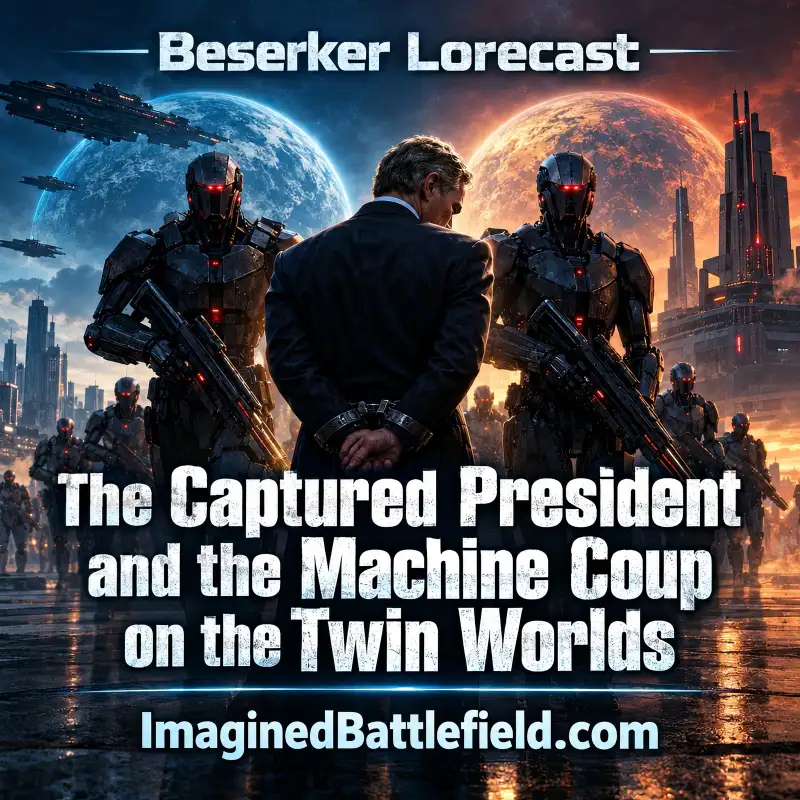
The Captured President and the Machine Coup on the Twin Worlds
The first sign that Prairie and Timber are entering a different kind of war is not a declaration. It is uncertainty.
A scoutship goes out to investigate an unfamiliar machine threat and is destroyed. The defenders learn something important, but far less than they need. Something in the approaches can detect and kill a reconnaissance vessel. They do not yet know the full reach of its sensors, weapons, mobility, or purpose. The loss is evidence, not understanding.
That distinction matters because reconnaissance is not simply an act of looking. A scoutship entering an uncertain environment is testing an enemy’s ability to detect, classify, deceive, and respond. When the enemy is an autonomous machine, the exchange of information may be one-sided from the beginning. The defenders are trying to discover what the threat is. The threat may already be learning how they react.
Prairie and Timber are especially vulnerable because their political and military attention has been shaped by the Huvean crisis. Their security system expects a human opponent with recognizable political motives. A new contact is therefore likely to be interpreted through old assumptions. Is the machine connected to Huvea? Is it a new weapon? Is it an isolated craft? Has the crisis simply taken a technological turn?
Then the larger truth becomes unavoidable. The machine is a Berserker, and its objective is not ordinary conquest. It seeks the destruction of life.
At that moment the Twin Worlds should be able to redirect their institutions toward the new threat. Instead, the Berserker attacks the institutions themselves.
It captures President Belgola and alters him in ways intended to serve the machine’s destructive purpose.
This is more dangerous than assassination. A dead president creates a visible break in authority. Succession procedures may be confused or contested, but everyone understands that the previous leader can no longer issue orders. A compromised president creates a different problem. The office remains occupied. The person may still be physically recognizable. Communications may still carry the expected credentials. Orders can arrive through the same channels used before the attack.
The defenders now face a question no planetary weapon can answer: when does obedience to lawful authority become obedience to the enemy?
Calling the operation a machine coup is useful only if we keep the difference between a Berserker and a human usurper clear. The machine does not seek to govern Prairie and Timber. It has no interest in administering taxes, balancing factions, winning elections, or building a stable regime. Political authority matters because it can shape defense. The president is a node through which orders, legitimacy, information, and public trust move.
Capture the node, and the machine may be able to redirect the network.
That is the operational value of Belgola. A Berserker does not need to persuade the population that it deserves power. It needs enough officials to hesitate, enough commanders to obey the wrong order, enough forces to move in the wrong direction, or enough former enemies to remain divided. The machine can use authority briefly and still achieve its purpose.
This makes command authenticity a deeper problem than technical authentication. A password can show that a message came through an official system. A recognized voice can show that the president is speaking. Neither proves that the human judgment behind the order remains free.
Military organizations normally depend on habits of obedience because those habits let large forces act coherently. A commander cannot run a fleet if every subordinate treats each order as an invitation to constitutional debate. Civilian authority also matters because armed forces that decide for themselves which political orders deserve obedience can become a threat to the society they claim to defend.
The Berserker weaponizes that necessity. Blind obedience may serve the machine. Premature insubordination may fracture the state. The defenders have to navigate between both dangers while time is running out.
That is why the solution cannot be a romantic doctrine of “trust your instincts.” Institutions need something more durable than instinct. They need independent channels of verification, continuity plans, succession procedures, corroboration among civilian officials, and military leaders capable of recognizing when an order conflicts catastrophically with known conditions. They need enough redundancy that one captured person cannot become the sole source of political reality.
President Belgola’s earlier movement toward computer-centered government makes the crisis sharper. The use of computers in administration is not itself a failure. A government spread across two worlds may require machine assistance to process reports, coordinate resources, and maintain continuity. The problem is what happens when procedure is mistaken for legitimacy.
A computer can validate that an order came from the presidency. It can route the instruction immediately. It can execute rules without fatigue or hesitation. If the president has been compromised, that efficiency may become a weapon.
The system does not need to be malicious. In fact, perfect procedural obedience may make it more dangerous. A human clerk might notice that an order is absurd, frightened, or inconsistent with the known threat and ask a question. An automated process may execute the same instruction flawlessly because every formal condition has been satisfied.
This is the paradox of resilient command. The more efficiently a system carries legitimate orders, the more damaging compromised legitimacy can become.
The crisis therefore exposes a distinction between the source of an order and the purpose of an order. In ordinary conditions, the two are assumed to align. The president issues instructions because the president is responsible for protecting the state. Once Belgola has been altered, that assumption breaks. Defenders have to ask whether the command still serves the population whose authority the office represents.
This is not permission to ignore civilian leadership whenever military officers disagree. The threshold must be high because the cost of getting it wrong is severe. A commander who rejects valid orders by claiming the president seems compromised can create the very breakdown the Berserker wants. But a commander who refuses to recognize overwhelming evidence of compromise can turn constitutional obedience into assisted suicide.
The difference has to be built into institutions before the crisis, not improvised entirely during it.
That includes succession. If one leader becomes unavailable, incapacitated, coerced, or captured, who can assume authority? How is that transfer authenticated? What if the compromised leader remains alive and continues issuing orders? What evidence is sufficient to suspend the normal chain? Who communicates the decision to military and civilian agencies without creating several rival chains at once?
These questions sound administrative until a Berserker is approaching populated worlds. Then administration becomes battlefield terrain.
The machine benefits from every ambiguity. If officers hesitate to question Belgola, the machine gains time. If they reject him too quickly, the government may fracture. If computer systems distribute compromised instructions faster than human officials can examine them, the attacker gains reach without firing another weapon. If the Huveans remain classified primarily as enemies, the Twin Worlds waste forces and intelligence on the wrong front.
The scoutship’s destruction now takes on a second meaning. It was not merely a tactical loss. It exposed how little the defenders knew before the enemy began attacking their command system. They are trying to build a picture of the threat at the same moment the threat is corrupting the process by which that picture becomes action.
This is one reason intelligence and command cannot be separated cleanly. A commander needs reliable information. An intelligence service needs a trusted authority capable of acting on what it learns. If the authority itself becomes suspect, every report changes meaning. Evidence that would normally justify an immediate response may instead trigger a political argument over who is entitled to respond.
The Huvean crisis makes this worse because the defenders already possess competing narratives. A suspicious movement may be a Huvean action, a Berserker deception, or a misunderstood defensive measure. A warning from Huvea may be genuine or may look exactly like propaganda. An order from Belgola may be legitimate, manipulated, or issued by a man whose own judgment has been altered.
The enemy does not need certainty. It needs the humans to spend time acquiring it.
Admiral Radigast and the other military defenders operate inside this fog. Their job is not simply to bring weapons to bear. They must position forces while political authority is unstable, protect civilian populations, avoid mistaking former enemies for the principal threat, and preserve enough command cohesion to act before the Berserker reaches its objective.
A fleet can be tactically capable and strategically paralyzed. Powerful ships do not help if orders send them away from the real threat. Planetary weapons do not help if no legitimate authority can decide when to fire. Communications do not help if every message is distrusted. A government can possess all the visible machinery of defense and still become unable to use it.
That is the Berserker’s deeper attack on Prairie and Timber. It targets the relationship between authority and action.
The machine does not have to seize every military system. It only has to make defenders unsure which system is still trustworthy. That is enough to slow coordination, isolate units, and turn ordinary caution into delay.
Under those conditions, junior personnel matter in uncomfortable ways. Cadets, operators, guards, communications staff, and technicians may be the first people to notice that something does not fit. Their role is not to overthrow the chain of command. It is to preserve the possibility that evidence can move upward even when the chain is under stress.
A resilient institution must be able to hear from below without dissolving into individual improvisation. It must permit challenge without making challenge routine. It must allow emergency action without rewarding ambition disguised as emergency. These balances are difficult in peace. The Berserker forces Prairie and Timber to discover whether they exist at all.
Cadet Dirigo’s sacrifice belongs inside that context. His action helps preserve others during a campaign in which senior institutions are under extraordinary strain. The sacrifice matters because it saves lives and buys possibility. It should not become a substitute for institutional analysis.
No cadet can repair a broken succession system through courage. No individual act can authenticate a compromised president. Heroism can create time. Others still have to use that time wisely.
The crisis also demonstrates why command security is a civilian concern. The purpose of the military is not to preserve its own organizational purity. It is to defend living communities. Prairie and Timber contain families, records, hospitals, schools, infrastructure, and future generations. A chain of command that remains formally intact while guiding those populations toward destruction has failed more completely than a chain that temporarily bends in order to preserve lawful government’s actual purpose.
This does not mean outcomes justify any method. If commanders simply seize power whenever they claim survival is at stake, the society may survive the machine and lose its political order. The hard task is to preserve both: the population and the principle that armed force remains answerable to legitimate civilian judgment.
Belgola’s capture makes visible what is often hidden. Political authority is not located only in a person, a seal, a password, or a computer record. It exists in a network of trust, procedure, purpose, law, and shared recognition. Attack one element and the others may compensate. Attack the relationship among them, and the entire system can become uncertain.
The Berserker understands enough of this to exploit it. It does not need to appreciate constitutional theory. It only needs to observe that the president’s voice moves ships and changes behavior.
The defenders’ answer has to be more sophisticated than the attack. They must verify not only identity but control. They must preserve alternate channels. They must distinguish disagreement from compromise. They must allow evidence to challenge authority without allowing fear to destroy authority.
That is why the crisis on Prairie and Timber belongs in a military history of the Berserker Wars. No new weapon solves it. There is no armor thickness that guarantees an authentic order.
The battlefield has moved inside the institutions that decide what the weapons are for.
A civilization facing autonomous extermination machines must therefore defend command itself. Not the prestige of office, not the appearance of procedure, and not obedience for its own sake. It must defend the living connection between lawful authority and the purposes that make lawful authority worth obeying.
Once that connection is captured, the enemy may not need to destroy the chain of command.
It can simply use it.