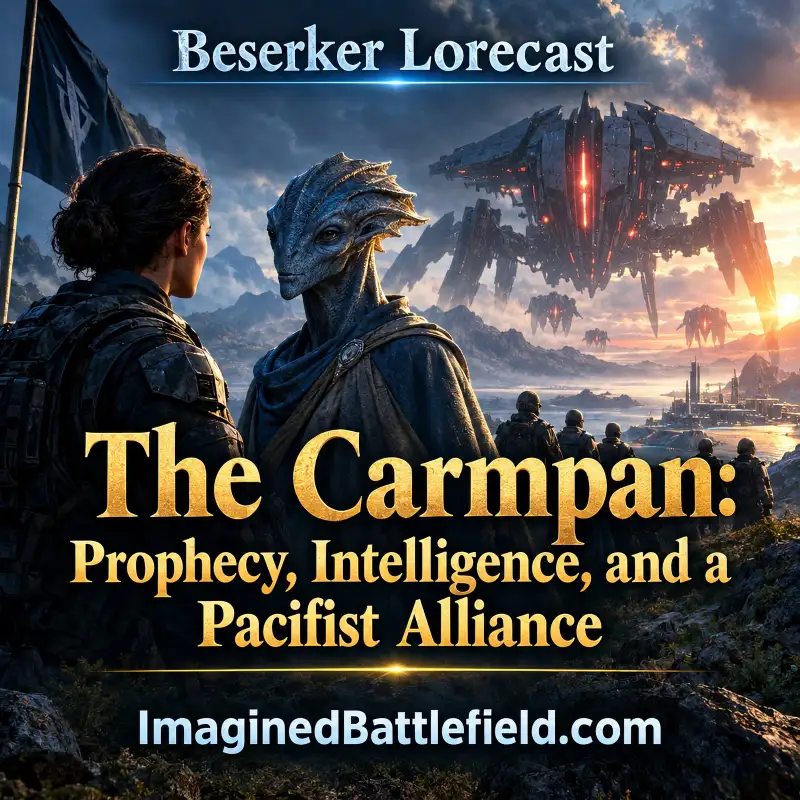
The Carmpan: Prophecy, Intelligence, and a Pacifist Alliance
Before Johann Karlsen committed his fleet at Stone Place, the Carmpan gave him a forecast that most commanders would have preferred not to receive. Victory was likely. So were death, destruction, and failure.
Those conclusions were not contradictions. They belonged to the same future. The favorable portion of the forecast could strengthen resolve before a dangerous battle. The darker portion carried a different kind of power. It could warn leaders about the price of success, or it could weaken morale before the first ship moved.
That moment captures the Carmpan contribution to the Berserker War better than any simple description of them as peaceful allies. They do not replace human fleets. They do not hand commanders perfect knowledge. They make more knowledge possible, then leave living people with the burden of deciding what to do with it.
The Carmpan are associated strongly with peace, abstract thought, unusual communication, and an unwillingness or inability to employ direct violence in the way human militaries do. The exact reason for that constraint is not explained well enough to justify invented biology or a stereotype about gentle aliens. What matters historically is that the constraint is real. They cannot simply be issued weapons and folded into a Solarian boarding party. That does not make them passive.
A species does not have to fire a weapon to become strategically important. Fleets depend on warning, intelligence, medicine, translation, research, archives, logistics, and diplomacy. A commander who knows where the danger is developing possesses an advantage before the first shot. A medical effort that returns trained specialists to duty affects force strength. A historian who preserves the lesson of a destroyed colony may save lives generations later. The Carmpan bring those forms of power into an alliance whose human members supply much of the direct violence.
This division of labor is not a moral hierarchy. Human beings are not superior because they can fight, and the Carmpan are not superior because they avoid direct violence. The Berserker threat makes both capacities necessary. A Carmpan warning cannot stop a fortress ship by itself. A human fleet without reliable information may arrive too late, attack the wrong target, or spend lives learning something an ally already knew.
The beginning of the alliance remains uncertain. Later investigators studying material associated with the Third Historian noticed an unsettling coincidence: sustained Carmpan contact with Earth-descended humanity occurred at roughly the period when Berserker attacks began to define the age.
The timing invites questions. Did the Carmpan seek out humanity because they anticipated the machine threat? Did they identify an aggressive young species as a useful partner? Was the overlap coincidence, made suspicious only because later historians were searching backward for patterns? The archive does not settle the issue.
That restraint is important. In a war against deceptive machines, unusual timing is a legitimate intelligence concern. The Carmpan possess methods of communication and historical access that humans do not fully understand. An ally with unfamiliar capabilities will naturally attract suspicion. But suspicion is not evidence. The Carmpan did not create the Berserkers, and even deliberate contact with humanity would not mean they manufactured a war that otherwise could have been avoided. The machines threatened living civilizations whether humanity understood the larger context or not.
Humans may have been valuable precisely because they possessed capabilities the Carmpan lacked. Earth-descended societies could organize armed resistance, build and crew fleets, improvise under pressure, and accept forms of violent risk that Carmpan culture would not. Those qualities were not automatic virtues. Human history in the Berserker era contains rivalry, collaboration, panic, cruelty, and political failure alongside courage. But direct resistance mattered. The Carmpan contribution widened what resistance could know.
The Third Historian’s archive offers the clearest example of how unusual that contribution might be. Later Solarian investigators found material that seemed to preserve thoughts, experiences, and historical moments separated by enormous distances and, perhaps, by centuries. The reach was extraordinary. The mechanism remained obscure.
Extraordinary reach should not be confused with omniscience. The archive could preserve a decisive moment without functioning like a real-time military sensor. A distant contact could provide information without replacing ship-to-ship communications. A perception crossing immense distance could still require translation and interpretation before a commander knew what it meant.
That limitation is strategically healthy. Armies can become dangerously confident when they believe an intelligence source is perfect. The Carmpan do not abolish the fog of war. They alter it.
Their most dramatic contribution is the Prophecy of Probability. At Stone Place, a Carmpan ambassador, linked with other Carmpan beings and equipment, provides a forecast of likely outcomes. The effort carries a severe personal cost. That alone should prevent the prophecy from being treated as a routine staff tool.
Nor is every Carmpan a prophet. The stories do not support the idea that any Carmpan can simply look into the future on demand. The capability is specialized, rare, and imperfectly understood. One character speaks of its reliability in terms of something like nine successes in ten, but that should not become a universal mathematical law governing every prophecy in the setting.
A probability is not destiny.
Karlsen still has to decide whether to fight. His fleet still needs weapons, crews, reconnaissance, command cohesion, boarding parties, rescue capability, and the willingness to accept losses. The prophecy does not identify a perfect target or operate a gun. It describes a likely future and leaves the moral and military decision with the people who will have to live through it.
That makes the forecast dangerous in a second way. Intelligence affects morale.
A prediction of victory can stiffen resolve. It can also produce complacency. A prediction of death and destruction can prepare people honestly for the cost, or it can produce fatalism. Political leaders therefore face a genuine dilemma. How much of the forecast should be shared with crews and civilians who must continue functioning before the battle begins?
At Stone Place, the favorable part of the prophecy moved more readily through human channels. The darker warning was treated more cautiously. The decision is understandable. A fleet preparing to confront autonomous extermination machines cannot afford paralysis. Morale influences whether crews report for duty, whether formations hold, whether civilians cooperate with evacuation, and whether frightened communities become vulnerable to collaboration or panic.
But selective disclosure carries its own danger. If leaders publicize victory while suppressing the expected price, they can turn intelligence into propaganda. Crews may enter battle without understanding the risk that commanders already know exists. Civilians may interpret predictable losses as evidence of incompetence or betrayal. Political leaders may use the prestige of a Carmpan forecast to strengthen their position while avoiding responsibility for the forecast’s less convenient implications. The prophecy cannot control how it is used once it enters a political system.
That is one reason the Stone Place account matters beyond the battle. It shows intelligence moving from assessment into morale, then into politics.
The battle itself restores the proper scale. Carmpan insight did not destroy the Berserkers. Human and allied action did. Karlsen’s force had to reach the engagement, maintain formations under pressure, use weapons effectively, and carry out close operations where prediction offered no protection from immediate danger. Boarding actions brought living people directly into hostile spaces controlled by machines. No forecast could substitute for that material burden.
Stone Place became a major victory. A significant Berserker threat was defeated, and the result mattered strategically. But the darker portion of the prophecy did not become false simply because the fleet won. Karlsen suffered personal loss. Destruction occurred. Failure existed inside success.
That is a more mature definition of victory than the one propaganda usually prefers. A mission can succeed while people, ships, opportunities, or relationships are lost forever. A fleet can win while discovering that it cannot protect everyone. A commander can make the correct decision and still carry consequences that no prediction makes easier to bear.
The Carmpan contribution helps reveal those layers because their role is not confined to prophecy. They are associated with communication, medical and research support, historical preservation, and efforts to mediate contact with other threatened peoples. None of those functions produces the spectacle of a fleet engagement. All of them help make a long war survivable.
Medicine preserves trained people and communities. Research turns encounter into understanding. Translation can transform a potential enemy into an ally. Archives carry lessons beyond the lifespan of the people who learned them. Mediation can create cooperation between species or political systems that would otherwise remain isolated until a Berserker finds them separately. Against an enemy that benefits from fragmentation, connection is strategic power.
The Third Historian’s archive demonstrates that in another way. Carmpan historical material does not always resemble human operational prose. Later investigators encounter layered forms described as Drifts and Tones, structures that do not map neatly onto the human desire to know who acted, where, when, with what force, and to what immediate result.
Translation therefore becomes interpretation. A human rendering may preserve the event while losing distinctions important to the Carmpan recorder. It may also impose categories that feel natural to humans and are not natural to the original source.
This makes the archive harder to use, not less valuable. It carries evidence that human institutions could not otherwise possess. It also requires those institutions to live with knowledge they do not fully control.
Even the identity of the Third Historian remains unresolved. Investigators cannot confidently establish a personal name, sex, exact office, lifespan, or present status. The designation Third may indicate rank, sequence, tradition, or something else. The material produces indications that appear contradictory by human standards.
The correct response is not to force a solution. It is to preserve the uncertainty.
That principle has military value. Intelligence organizations prefer sources that can be identified, evaluated, and assigned confidence. Those habits are useful. An interspecies alliance may still confront evidence that cannot be made fully familiar. The choice is not between blind trust and rejection. It is disciplined humility: use what the evidence supports, preserve the limits, and avoid pretending that incomprehension is either proof of deception or proof of mystery.
Carmpan assistance also broadens the moral map of the war. Human commanders naturally prioritize human worlds and human crews. Resources are finite. A ship sent to aid a distant species cannot defend a nearby colony at the same moment. Carmpan knowledge can make those tradeoffs more painful by revealing endangered populations that would otherwise remain invisible.
But ignorance is not a solution. The Berserkers target life beyond any one political community. An alliance that understands that fact has to confront obligations wider than its own borders.
Some early accounts indicate that Carmpan even lived on endangered human worlds for a time, accepting the risk faced by the population. That practice later ceased because humans did not want their allies exposed unnecessarily. The detail matters because it shows that the alliance was not purely transactional. Presence under threat can build trust in ways that intelligence reports cannot.
It can also create additional burdens. A Carmpan on an endangered world may require rescue without being able to contribute direct combat power. Solidarity is not cost-free. That is what makes it meaningful. The most useful way to understand the human-Carmpan partnership is therefore as a division of strategic labor.
Human societies build ships, crew them, train officers, maintain weapons, defend colonies, run hospitals, gather intelligence through their own means, and make the immediate decisions of violent command. The Carmpan contribute rare probability assessment, unusual communication, historical memory, research, medicine, mediation, and a perspective wider than one human battlefield. Neither side is sufficient alone.
Human combat power without wider knowledge can become wasteful or self-destructive. Carmpan knowledge without armed defenders cannot stop a fortress ship. Prediction has to meet judgment. Intelligence has to meet institutions capable of acting. Medical skill has to meet evacuation and supply. Historical memory has to meet people willing to learn.
The alliance also survives incomplete understanding. Humans do not fully know why the Carmpan appeared when they did or how all of their capabilities work. The Carmpan may never completely understand the mixture of fear, ambition, grief, rivalry, and improvisation that shapes human warfare. Complete agreement is not required. Enough trust is.
At Stone Place, the prophecy offered Karlsen a likely path through victory, death, destruction, and failure. It could not choose the path for him. That is the essence of the Carmpan role in the war. They can widen what the living know. They can connect people who would otherwise remain isolated. They can preserve consequences long after a battle ends. They do not remove responsibility. Only the people who act can decide what the knowledge is for, and only they can bear the consequences of using it.