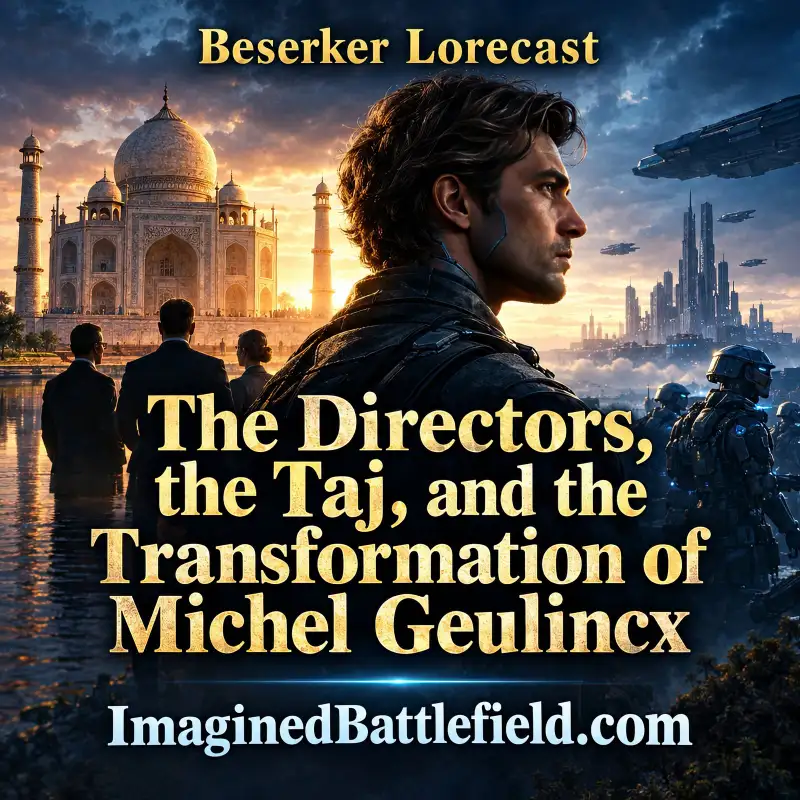
The Directors, the Taj, and the Transformation of Michel Geulincx
The Berserkers capture an eleven-year-old enemy combatant, and they do not kill him. They preserve him. They test him, question him, watch his sleep and exercise, regulate his confinement, and move him across interstellar distance toward a destination near the galactic Core. For machines built to exterminate life, this is not mercy. It is an intelligence operation. Michel Geulincx has become too important to destroy before the machines understand what he is.
To the Solarian authorities, Michel had been a weapon of last resort. To the specialized Berserker called the Co-ordinator, he was an anomaly requiring controlled exploitation. To the Directors waiting near the Taj, he appears to have been connected to a problem older and stranger than any ordinary military campaign. But Michel is also a child, with a history obscured even from him, relationships he only partly understands, and a mind that no institution has the right to reduce entirely to its usefulness.
That conflict over definition is the center of Berserker Man. The novel does not merely ask whether one exceptional human can defeat machines. It asks what happens when human command, autonomous weapons, and an unknown force near the Core all attempt to turn one life into an instrument. The Berserkers may have helped shape Michel for their own purpose. In doing so, they appear to have created the one person capable of reaching the Taj in a way they could neither predict nor control.
His capture transfers him from one architecture of control to another. The Solarians have treated him as a scarce and valuable weapons capability. The Berserkers treat him as a scarce and valuable intelligence problem. In both cases, the immediate question is what Michel can do. In both cases, the deeper question is whether anyone really knows what has been made.
The Co-ordinator’s role must be understood precisely. This machine is not presented as the supreme commander of all Berserkers. It should not be mistaken for a single galactic mind, or for proof that every Berserker unit answers to a neat universal hierarchy. It is a source-specific specialized machine, associated with Michel’s capture, transport, interrogation, and management. Its function is closer to an exploitation platform than to an ordinary prison guard.
The Co-ordinator does not simply inflict pain in the hope that Michel will reveal useful information. That would be a crude approach, and crude approaches often destroy the very source one is trying to exploit. Instead, Michel’s captivity is controlled. He is confined, observed, questioned, exercised, and subjected to carefully managed contact with human intermediaries. His physical and mental condition matters to the machines because a damaged Michel may be less useful than a living, functional, responsive one.
That behavior tells us what the Berserkers do not know. They know that Michel is unusual. They know that Lancelot is dangerous. They know that the boy’s existence is connected to a larger problem centered on the Taj. But their need to monitor, question, and preserve him suggests that they do not possess a complete explanation. They have evidence. They have a project. They have an objective. They do not have mastery.
The Co-ordinator is conducting intelligence work under conditions of uncertainty. It seeks to determine the nature of Lancelot, the source of Michel’s unusual responses, the meaning of his history, and the significance of the Taj. None of these questions can be answered merely by dismantling equipment or scanning a prisoner’s body. The problem includes memory, personality, perception, and the unpredictable ways a living person may respond to fear, attachment, deception, and confinement.
The use of Goodlife-associated personnel sharpens that problem. The Berserkers employ living intermediaries because living people can speak to prisoners in ways machines cannot. They can ask questions with emotional nuance. They can interpret silence, evoke memory, offer comfort, apply pressure, and make captivity feel temporarily familiar. They can also operate within the complicated field of human trust, where a gesture may be sincere, manipulative, coerced, or all three at once.
Stal, Hoshi, Elly, and the other human figures associated with Michel’s captivity should not be treated as identical examples of collaboration. The Berserker term Goodlife describes living people who assist the machines against other life, but it does not explain why any particular person does so. Fear, coercion, desire for survival, personal belief, opportunism, prior entanglement, and emotional damage can produce very different forms of cooperation. The machines benefit from that difference. A divided human population is easier to exploit than a united one.
Elly’s presence is especially important because the novel gradually connects her to Michel’s obscured biological history. The available revelations point toward her as his likely biomother, but the family record is not presented as a clean administrative file. It comes through partial recognition, pressure, and discovery. That uncertainty is dramatically important. Michel’s captors are not merely questioning a military operator. They are working inside the damaged and concealed history of his origin.
For the Berserkers, human intermediaries are useful because they provide cultural access. They can help manage a child, identify emotional leverage, and present machine objectives in human language. Yet they are also a counterintelligence hazard. A collaborator may lie. A coerced assistant may resist in small ways. A person seeking survival may withhold information from both sides. The machines can use human beings as interfaces, but an interface is not a transparent window.
The presence of Goodlife personnel also widens the moral cost of the operation. Michel’s captivity is not a sterile contest between a boy and a machine. It is a system of occupation and exploitation in which living people become instruments of an extermination campaign. The machines do not need to understand love, guilt, or loyalty in the human sense to use those forces. They need only recognize that these forces can influence behavior.
Yet even this network of observation cannot resolve the central mystery. Michel’s destination is not simply another prison, machine base, or battlefield. He is being carried toward the Directors and toward the Taj, a location where the ordinary vocabulary of military intelligence begins to fail.
The Directors are associated with the Taj project and with the deeper manipulation of Michel’s life. What can be said with confidence is limited. They are a group of specialized Berserker authorities or entities linked to the region near the Core. They have an interest in determining what the Taj is, whether it is alive, and whether it should be destroyed. They are also connected to the design or management of the circumstances that made Michel relevant to that question.
What cannot be said with confidence is just as important. The Directors are not established as a single unified artificial intelligence. They are not demonstrated to be the supreme rulers of every Berserker machine across the galaxy. Their number, internal hierarchy, degree of independence, and relationship to other Berserker operations remain unclear. It would be comforting to imagine an enemy command structure with a central headquarters. The novel offers something more troubling: specialization without full transparency.
The very existence of the Directors shows that Berserker systems face problems of classification and delegation. The Co-ordinator can capture and exploit Michel. It cannot settle the Taj question on its own. The Directors are involved because the anomaly exceeds the Co-ordinator’s remit. Even a distributed extermination system must assign difficult problems to particular machines, gather incomplete evidence, and decide how much uncertainty it can tolerate before acting.
For a machine built around the destruction of life, classification is not an abstract philosophical exercise. It is a targeting problem. If the Taj is alive, it belongs within the Berserker mission. If it is not alive, its destruction may be irrelevant or counterproductive. If it is something that can alter the meaning of life, intelligence, or agency, then the machines face a category their original programming may not have prepared them to understand.
The Taj stands near the galactic Core, immense and anomalous. It appears associated with life, or with something life-like enough to provoke Berserker interest. Beyond that, certainty falls away. The Taj may be a structure. It may be an entity. It may be a form of intelligence. It may be something for which those terms are all inadequate. The novel does not provide a technical manual, a reliable blueprint, or a final cosmological explanation.
That uncertainty should not weaken its military significance. On the contrary, uncertainty is the reason the Taj matters. A fortress ship can be targeted. A machine base can be located, attacked, or avoided. A known species can be studied through biology, behavior, and communications. The Taj resists that kind of ordinary assessment. It is a strategic object because both sides must act in relation to it without securely knowing what it is.
The Berserkers’ concern is especially revealing. Their purpose is closed: find life and destroy it. But the Taj forces them to ask whether a thing belongs inside the category of life at all. That is not merely a sensor problem. It is a problem of meaning. A machine can examine matter, detect patterns, and compare observations against stored definitions. It may still fail when confronted with a form of existence that does not fit its inherited target categories.
Michel matters because his existence appears tied to the attempt to approach or understand the Taj. The link is not reducible to one cause. His biological origins, his extraordinary mind, his relationship with Lancelot, his human relationships, and his later experience all contribute to the person he becomes. The Berserkers may have manipulated some part of his origin for their own Taj-related purpose. But manipulation is not the same as authorship.
This is the novel’s central irony. The machines appear to have cultivated a human instrument because they needed a living being capable of serving as a probe, key, intermediary, or test case. They did not simply stumble across Michel after the Solarians made him valuable. Their interest reaches deeper. But if they hoped to create a controlled biological tool, they failed to account for what happens when a living person develops through experience.
A living child does not remain an initial condition. Michel is affected by training, danger, family revelation, military expectation, captivity, friendship, fear, and the strange relationship with Lancelot. He is not the sum of his biological origin. Nor is he merely the product of Solarian weapons engineering. The Berserkers may have shaped a beginning. They do not demonstrate ownership of the outcome.
That distinction matters because it prevents a false reading of the story. The Berserkers did not knowingly design a successful human superweapon and accidentally hand it to their enemies. The result is stranger than that. They appear to have pursued an experiment connected to the Taj, only to discover that human growth, personal agency, and technological integration had produced a being who could no longer be treated as a predictable instrument.
Lancelot is part of that outcome, but it is not the whole explanation. It changes Michel’s perception and capacity. It makes him more than a normal child and more than a normal combatant. But it does not erase his humanity, or turn him into a machine. Likewise, the Taj does not simply install a final upgrade. The final transformation cannot be explained as a more powerful version of the same equipment.
The Solarians understand enough to know that Michel’s capture is catastrophic. They do not understand enough to know precisely where he is being taken, what the Berserkers intend, or what the Taj will do. Carmen, Tupelov, Marcus, and the wider command structure must work from inference. They identify the likelihood that Michel is being moved toward the Directors and the region where the Taj was last reported. That is not omniscience. It is a judgment made under pressure.
The human response is pursuit. Strategically, it is necessary. Michel is too important to abandon, both as a person and as the only known operator of a unique system. The Taj is too dangerous to leave entirely to Berserker investigation. But pursuit toward the Core is not a clean rescue operation. It requires ships, coordination, communication, and the willingness to commit resources across interstellar distances without secure knowledge of the destination, the enemy disposition, or the time remaining.
The novel does not support a neat order of battle. We do not need invented fleet numbers to understand the difficulty. Human forces cannot simply turn toward the Core and arrive as soon as the plot requires. Ships must be assembled. Information must be shared. Commanders must decide what risks to accept. Reinforcements may be delayed, divided, or operating on assumptions that later prove wrong. Distance remains a strategic fact, even in a civilization capable of interstellar war.
There is also a political problem. Solarian command has built a major part of its hope around Michel, yet it cannot reliably protect or command him. The same institution that identified his value now confronts its own dependence. If he is recovered, can he return to the role assigned to him? If he is changed, who has authority over him? If he reaches the Taj before the fleet does, what exactly are the pursuers trying to recover: a child, a soldier, a weapon, or an unknown new entity?
These questions cannot be solved by issuing better orders. Command depends on legibility. A military organization needs to know what its personnel are capable of, what risks they face, who gives instructions, and what outcomes can reasonably be expected. Michel’s movement toward the Taj steadily removes him from that system of legibility. The human pursuit can demonstrate loyalty and strategic responsibility. It cannot restore the old assumption that Michel is an asset waiting to be retrieved.
The decisive event comes in Michel’s encounter with the Taj. Here the novel moves beyond the familiar language of weapons systems and battle damage. Michel undergoes a change that is physical, cognitive, and ontological. The word ontological is necessary, if a little unfriendly to the ear. It means a change in what kind of being someone is understood to be. Michel does not merely become stronger. The terms used to describe him no longer seem adequate.
This is not the moment when he becomes a Berserker. He does not become an enemy machine wearing a human history. Nor does he simply become Lancelot’s permanent operator in a more advanced configuration. The transformation is related to Lancelot because his prior integration with that system has already altered the ways he perceives and acts. But the Taj event exceeds a final stage of equipment installation.
The novel presents Michel as gaining access to extraordinary knowledge or realities beyond ordinary human understanding. It does not establish that he becomes omniscient. It does not provide a firm engineering explanation for how he knows what he knows, or what the ultimate boundaries of his new awareness may be. Any attempt to reduce the transformation to a technical specification would miss the point. The uncertainty is part of the event.
What changes is not simply Michel’s power. What changes is the ability of others to define him. The Solarians can no longer confidently see him as their specialized weapons operator. The Co-ordinator can no longer treat him as a manageable intelligence subject. The Directors can no longer regard him as a controlled result of a Taj-related experiment. Each system has tried to make Michel readable. Each finds that its categories have failed.
That does not mean Michel floats free of all human connection. His history still matters. His childhood still matters. His relation to Frank Marcus, Elly, Lancelot, and the Solarian cause still matters. Transformation does not erase the moral record of how he was used. If anything, it makes that record more painful. A person may become capable of extraordinary action and still have been denied ordinary protections when those protections were most needed.
There is also a cost hidden inside every story of transcendence. To become more capable is not automatically to remain comfortably oneself. Michel’s new state raises questions of continuity. How much of the boy from Alpine remains accessible? How much of his ordinary human belonging can survive? What does it mean for family, command, friendship, or responsibility when one participant has crossed into an experience others cannot fully share? The novel leaves those questions open because it knows there is no simple answer.
Michel’s transformation is therefore not a simple victory parade. It is a strategic reversal, but it is also a warning. The Solarians were right to resist the Berserkers. They were right to recognize that conventional methods alone might not suffice. They were not entitled to assume that any power created in defense of life would remain a manageable tool. Military necessity can justify difficult choices. It cannot guarantee wisdom.
The Berserkers appear to have shaped Michel for a Taj-related purpose. They recognized something unusual in his origin and sought to exploit it. They captured him alive because they believed the answer to their own uncertainty lay inside him. But they never demonstrate mastery over the person they have helped create. Their great failure is not merely that they overlook a weapon. It is that they fail to understand that a living person cannot be fully reduced to one.
The Solarians fail in a different way. They see Michel more humanely than the Berserkers do, but they also see him through the needs of war. They make him the bearer of their hopes because he is rare, gifted, and useful. In doing so, they risk confusing care with control. When the Taj changes him, they must confront the possibility that saving Michel is not the same thing as returning him to the place they assigned him.
The final reversal in Berserker Man is not that a boy receives greater firepower. It is that the attempt to create a controlled strategic instrument breaks down on both sides. The Berserkers cannot turn Michel into a predictable probe of the Taj. The Solarians cannot permanently define him through Lancelot and military service. The Taj reveals a transformation that neither programming nor bureaucracy can fully contain.
That does not end the Berserker War. It does not make fleets unnecessary, erase the need for industry, or guarantee that humanity has found a final answer to autonomous extermination. What it does is expose the limits of every system that mistakes capability for wisdom. The machines can create, capture, test, and classify. Governments can train, command, and deploy. Neither action proves that its maker understands the life it has placed in motion.