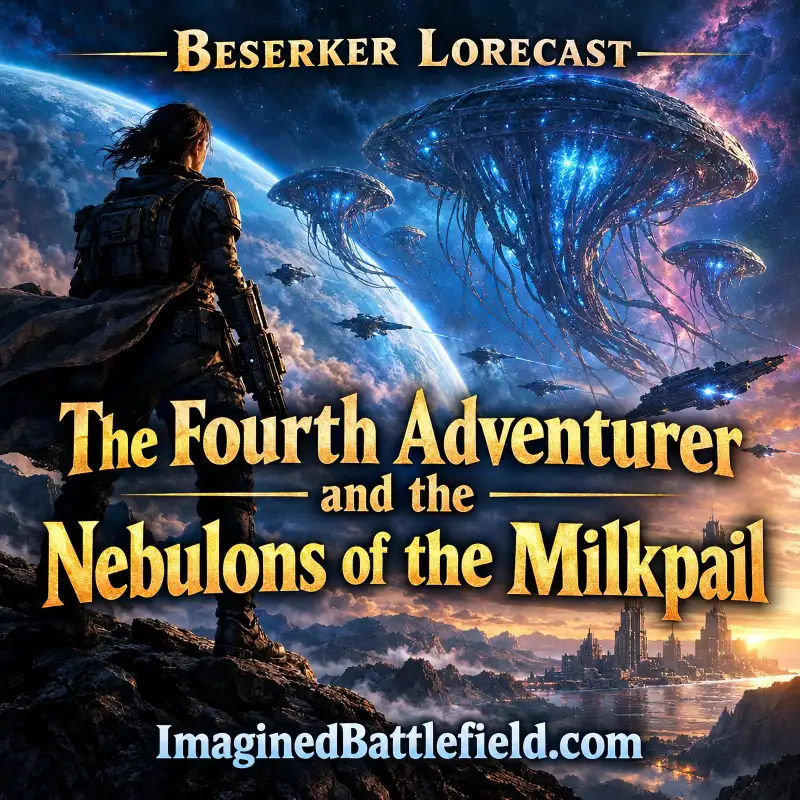
The Fourth Adventurer and the Nebulons of the Milkpail
Leviathan could be hunted only if the hunters learned what kind of place the Milkpail really was. Domingo entered the nebula thinking chiefly in human terms: colonies, routes, ships, resources, and an enemy hiding among them. The Fourth Adventurer forced a larger map upon the expedition.
Human communities had come to the nebula because it offered concentrated resources. That made settlement possible and worthwhile. It also encouraged a certain way of seeing the region. Colonists saw usable material, difficult routes, sheltered outposts, and the economic opportunities of a place other people had not fully exploited. Those were reasonable observations. They were not complete observations. The Milkpail was not empty terrain waiting to be divided into shipping lanes and extraction sites. It contained conditions that human surveys had not fully interpreted. Its matter and energy flows were not merely obstacles to instruments or sources of material wealth. They were part of an environment in which other forms of life existed and moved.
That distinction changes the strategic meaning of the nebula. At first, human ignorance appears to concern the enemy. The colonists do not know where Leviathan is, what route it will take, or what it has learned from its previous attacks. Those are serious intelligence failures. But the deeper ignorance concerns the battlefield itself. The humans know the Milkpail as an industrial and navigational environment. They do not yet understand it as an inhabited intelligence environment. Their maps show colonies, hazards, resource concentrations, and probable approaches. They do not adequately show other actors. In military terms, they have mistaken a populated operational area for empty space between their own installations.
The Fourth Adventurer enters the expedition at precisely that point. This Carmpan participant does not make the Sirius Pearl stronger in any simple or conventional sense. The Fourth Adventurer does not arrive with a larger gun, a fresh squadron, or a perfect prediction of the Berserker’s next move. The contribution is more difficult to classify, and therefore more important. The Fourth Adventurer is interested in making contact with unusual intelligences associated with the Milkpail’s strange flows of matter and energy. Domingo sees the nebula as the place where the Blue Death has hidden. The Fourth Adventurer sees the possibility that the nebula has inhabitants.
That difference in perception is the beginning of the coalition. It is also a reminder that the Carmpan cannot be reduced to a single stereotype. They are often associated with peaceful principle, historical memory, and forms of knowledge that human military institutions do not possess. None of that means every Carmpan is identical, or that every Carmpan can do what the Fourth Adventurer does here. Nor does it mean that the Fourth Adventurer’s presence turns the campaign into a standard Carmpan military operation. This is an exceptional individual participation in a dangerous human mission. Its importance lies not in proving that the Carmpan have become ordinary combatants, but in showing what an allied species can contribute when its understanding of a problem differs fundamentally from humanity’s.
The Fourth Adventurer’s task is not simply to discover a useful resource. It is to attempt communication across a boundary that human instruments and categories have failed to cross. That makes the role closer to intelligence work, diplomacy, and translation than to direct command. A contact of this kind cannot be taken for granted. The beings encountered in the Milkpail do not need to share human language, human institutions, human fears, or human ideas about war. They may not distinguish a mayor from a ship captain. They may not understand what a colony is, why people gather for a wedding, or why Domingo’s pursuit is tied to personal grief. The first requirement is not agreement. It is recognition.
The beings the Fourth Adventurer helps bring into contact with the expedition are the Nebulons. They are sentient inhabitants of the Milkpail, distinct from human colonists, distinct from the Carmpan, and utterly distinct from Berserker machines. Their nature resists easy translation into the categories humans normally use for living things. It is safer to say that they are associated with the nebula’s unusual physical environment than to force them into a familiar biological model. What matters operationally is that they belong to the Milkpail in a way the human settlers do not. They perceive, move through, and respond to that environment by means humans cannot simply duplicate with better ship equipment.
The Nebulons are not immediately converted into members of Domingo’s command. That would be a comforting but false image of coalition warfare. They do not become a subordinate squadron, and Domingo does not suddenly gain authority over them because his ship is present. There is no reason to assume that they understand human ranks, accept human discipline, or share every human objective. Their cooperation emerges because Leviathan presents a common danger. The Berserker’s purpose is the destruction of life. Whatever the Nebulons’ own social structure or perception of danger may be, a machine operating violently within their environment is not a neutral presence. It threatens the living character of the Milkpail.
The Fourth Adventurer’s achievement is therefore not recruitment in the ordinary military sense. It is the creation of practical intelligibility. The human expedition can make its purpose known well enough for the Nebulons to respond. The Nebulons can become known as actors rather than phenomena. And a shared problem can be identified without pretending that the parties have become culturally identical. This is how a real coalition begins. Not with a speech about common values, and not with the convenient discovery that everyone already wants the same thing, but with an imperfect recognition that separate lives are endangered by the same enemy.
For Domingo, that recognition changes the nature of his hunt. Before contact, the mission depends on the Sirius Pearl’s ability to keep searching. It is a small human force pursuing a powerful machine through terrain that favors concealment. After contact, the expedition possesses access to a form of environmental knowledge that no ordinary colonial patrol could provide. The advantage is not simply that the Nebulons know where Leviathan is at every moment. The account gives no basis for imagining them as omniscient observers. The advantage is that the Blue Death no longer operates in an environment defined only by human senses and human limitations. The machine has been hunting among living beings whom the colonists barely knew existed.
The Nebulons disrupt that expectation. They are not a hidden reserve force waiting for human commanders to activate them. Their participation is contingent, and it carries risk. The prospect of approaching the Berserker is frightening even to beings whose relationship to the Milkpail differs from that of human crews. That fear matters. It prevents the Nebulons from becoming a fantasy weapon. They are living participants, not a feature of the landscape. They must decide whether the danger posed by Leviathan justifies moving toward a machine whose destructive capacity they have reason to dread. Cooperation does not erase fear. A coalition exists precisely because its members act despite fear, uncertainty, and incomplete mutual understanding.
The same is true for Domingo and the Sirius Pearl’s crew. They have no reason to assume that contact will produce reliable help at the moment they need it. A human captain accustomed to formal command relationships might find the arrangement maddening. There is no standard chain of command across such differences. No shared doctrine guarantees how information will be interpreted. No human officer can simply issue an order and expect a Nebulon response. The Fourth Adventurer can make communication possible, but communication does not eliminate the need for judgment. Each participant must decide what risk to accept, what information to trust, and what kind of action is possible against the Blue Death.
That is why the final attack is best understood as an improvised combined operation rather than a straightforward duel. Domingo’s human force remains essential. The Sirius Pearl is the expedition’s durable human platform, carrying the people who have committed themselves to the hunt and capable of acting directly against the Berserker. Domingo’s determination gives the operation persistence. He has refused to let Leviathan disappear again into the Milkpail after Shubra. The Fourth Adventurer remains essential because the relationship with the Nebulons does not exist without the contact that has been established. And the Nebulons remain essential because they bring the campaign into an operational space that human ships and human senses cannot define by themselves.
The machine faces not one enemy but a convergence of unlike capabilities. That convergence matters more than any claim that one side possesses a decisive superweapon. Human beings bring shipborne endurance, a focused objective, and the willingness to pursue the Blue Death through conditions that should have discouraged a smaller force. The Fourth Adventurer brings the ability to make contact across an otherwise impassable divide. The Nebulons bring a native relationship to the Milkpail that alters the search and the approach. None of those contributions is sufficient alone. The human expedition cannot compel the nebula to yield Leviathan. The Nebulons do not become a human strike force. The Carmpan participant does not destroy the Berserker through diplomacy. Together, however, they deny the Blue Death the advantage of fighting only according to the categories it has already learned to manage.
The attack itself should not be reduced to a catalog of weapons fire and maneuver. The decisive fact is coordination under conditions of radical difference. A Berserker is designed to make destruction an engineering problem. It classifies life, identifies concentrations of it, and applies force. It expects resistance, but resistance of a recognizable kind. It can confront ships, weapons, defenses, and frightened populations. What it encounters in the combined operation is harder to reduce to a single model. The people on the Sirius Pearl are pursuing a machine that has made grief part of their mission. The Fourth Adventurer is acting across a boundary of perception and communication. The Nebulons are entering danger in defense of an environment humans had misread as largely uninhabited.
The result is a major tactical success. Leviathan, the Blue Death, the machine that destroyed Shubra and haunted the Milkpail’s colonies, is defeated. Domingo’s immediate mission succeeds. The particular Berserker that had turned a gap in Shubra’s defenses into catastrophe no longer threatens another settlement. For communities that had lived under its shadow, that outcome has real value. It removes a predator from their region. It proves that the machine can be found and destroyed. It may restore a measure of confidence to people whose defensive systems had been exposed as painfully inadequate.
But victory does not restore Shubra. It does not reverse the deaths caused by the attack, and it does not transform Domingo’s grief into something clean or resolved. Military success is often asked to carry burdens it cannot bear. Destroying the enemy may be necessary. It is not the same as repairing the world the enemy destroyed. For Domingo, the Blue Death’s defeat answers the demand that it not be allowed to continue. It cannot make the loss of his daughter acceptable, and it cannot justify every danger assumed during the pursuit merely because the pursuit ends successfully. The distinction matters because revenge is not made wise by being fulfilled.
The operation also produces an intelligence result that reaches beyond the destruction of one machine. The humans of the Milkpail learn that their environment contains living actors they had failed to recognize. That knowledge does not hand them a permanent defensive system. It does not tell them that every strange nebular phenomenon is sentient, or that every future crisis can be solved by asking the Nebulons for help. The Nebulons are not transformed into a standing military alliance, and the Fourth Adventurer’s role is not evidence that every Carmpan can establish such contact. Still, the campaign has changed the human understanding of the theater.
Before Leviathan’s defeat, the Milkpail could be imagined as a collection of human outposts scattered through difficult but exploitable terrain. After contact with the Nebulons, that image is no longer adequate. The nebula is a living environment with its own inhabitants, perceptions, and stakes. Any future human plan for settlement, extraction, defense, or travel must account for that fact. This is not merely an ethical correction, though it is certainly that. It is also a strategic correction. The failure to recognize other life had made the human colonies less secure because it had left valuable knowledge, possible cooperation, and local warning outside their understanding.
Nor should the Fourth Adventurer’s role be misread. The Carmpan participant is crucial, but not as proof that peaceful allies are secretly waiting to become military specialists. The Fourth Adventurer’s importance lies in making connection possible. In a war against machines organized around a fixed purpose, that kind of connection can be decisive. It expands the number of beings who can recognize the threat, share information, and choose to act. But it remains difficult, contingent work. There is no evidence that contact with the Nebulons becomes effortless, permanent, or universally transferable. A bridge is not the same as a highway.
The real change in Domingo’s campaign is therefore conceptual before it is tactical. He begins by hunting a known enemy. Leviathan has a name, a history of attacks, and a personal place in his grief. The mission is focused on one machine. Yet the pursuit succeeds only when the hunt becomes something larger than the relationship between Domingo and the Blue Death. It becomes an operation shaped by the Fourth Adventurer, by the Nebulons, and by the recognition that the Milkpail is not empty space in which human colonies happen to be trapped with a Berserker.
That recognition is the Fourth Adventurer’s enduring contribution. The Carmpan does not merely find allies for Domingo. The Fourth Adventurer changes the definition of the battlefield. A nebula that human colonists had treated as resource field, navigational hazard, and concealment zone becomes a place inhabited by other intelligence. Once that is understood, Leviathan’s position changes as well. It is no longer hunting among humans who see only themselves and the machine. It is operating within a living environment that can resist it in ways its previous attacks had not fully accounted for.
The Nebulons do not make the human cause pure, and they do not turn the war into a simple fable about friendly aliens rescuing the colonists. Domingo remains a grieving leader whose pursuit carries both public necessity and private pain. The humans remain settlers who had not understood the full character of the region they were exploiting. The Nebulons remain their own beings, not extensions of human command. The coalition works because these differences are not magically erased. They are made usable against a common threat.
Leviathan’s defeat is local. It does not end the Berserkers, repair Shubra, or solve the permanent military problem of defending dispersed life across interstellar distance. But it reveals a larger truth about the war. A Berserker can learn the routes, habits, defenses, and fears of the people it attacks. What it cannot safely assume is that human knowledge defines the whole field of life around it. The Blue Death is defeated when Domingo’s hunt stops treating the Milkpail as empty space between colonies and begins to recognize it as a place where other lives are present, aware, and capable of choosing to resist.