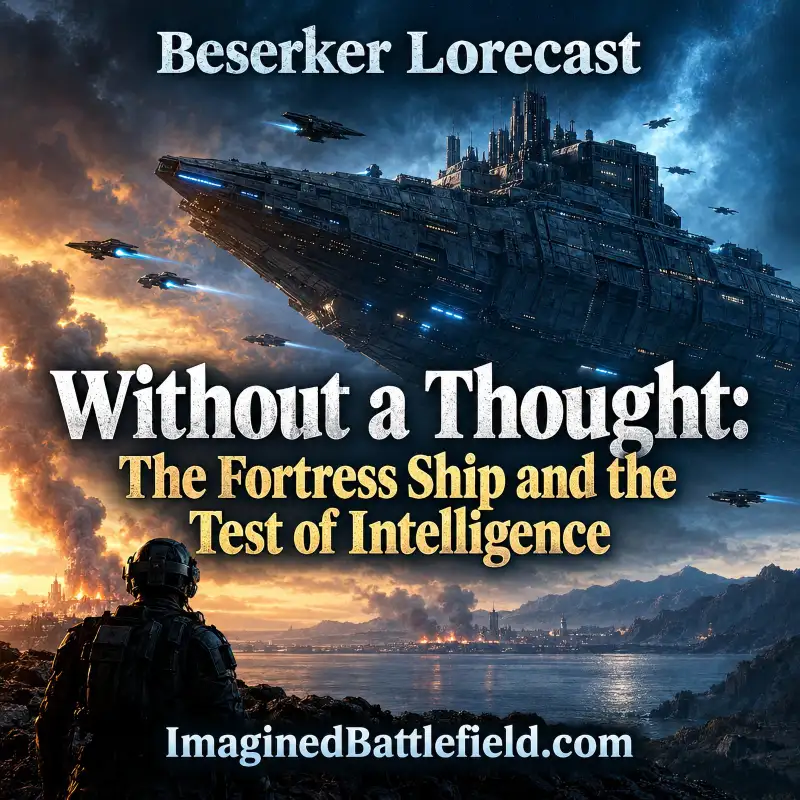
Without a Thought: The Fortress Ship and the Test of Intelligence
A human colony was already dead.
Its world had not merely lost a battle. The fortress ship had reduced the surface to dust and steam, erasing the population along with the institutions that had made the planet a home. Near that ruined world, one damaged fighter remained within reach of the machine responsible.
Its pilot, Del Murray, was not going to avenge the colony by himself. His task was more immediate and more difficult. He had to stay alive, keep the Berserker occupied, and prevent it from moving toward another living target until help arrived.
The machine facing him was a Berserker fortress ship, an autonomous weapon built on a scale far beyond Del’s fighter. The dead colony behind them demonstrated what its anti-life mission meant in practical terms. There was no political bargain capable of making this machine a tolerable neighbor. The useful objective was delay. Delay was the time in which the rest of the human defense might become strong enough to kill it.
Del’s fighter had been damaged by a near miss. Repairs could not wait for a shipyard or maintenance crew. He had the tools and systems aboard a one-person craft, plus Newton.
Newton was an aiyan, an animal companion large and dexterous enough to manipulate tools and perform practiced physical tasks. Its appearance suggested something between a large dog and a creature with ape-like forelimbs, but appearance was not the important part. Newton could learn routines. It could respond to signals. It could operate physical controls under conditions for which it had been trained. Those abilities were about to become more valuable than abstract intelligence.
The local defense was dispersed. Foxglove and Murray were holding the Berserker near the star. A third ship, Gizmo, was moving toward them at C-plus velocity, outside normal space and unable to participate in ordinary communication while in transit. Gizmo was coming, but it was still hours away.
That made the engagement a holding action rather than a duel. Del did not need to defeat the fortress ship alone. He needed to prevent it from breaking away. Retreat might save his fighter and expose another colony. In a war against extermination machines, personal survival and mission success are not always the same thing. Then the Berserker changed the nature of the fight. It used force fields to restrict Del’s escape and activated a weapon that attacked planning itself.
The effect was stranger than simple unconsciousness. Del could still perceive, speak, and move. His equipment still existed. But the higher process that allowed a mind to compare alternatives, predict consequences, and build an adaptive plan was being degraded. The weapon did not merely remove information. It damaged the ability to turn information into useful choice.
That made it especially dangerous. A pilot who knows the controls are dead can respond to a clear failure. A pilot whose instruments remain visible while the capacity for judgment disappears may continue acting long after he should no longer trust his own decisions.
The fighter’s electronic systems suffered a similar effect. Components were not simply burned out. The capacity to process alternatives in a useful planning sense was impaired. The Berserker was attacking command and control at the level where data becomes intention.
There was, however, a limitation. While the machine used this weapon, it also lost much of its own ability to plan and predict. That appears to be a feature of this particular device, not a universal law of Berserker warfare. But in this battle it created a narrow opening. If the weapon suppressed the kind of planning used by both Del and the Berserker, could something aboard the fighter continue to act without that kind of planning?
Newton could.
That answer can be made too dramatic if we are careless. Newton did not suddenly become a human-level strategist. The aiyan did not understand the whole battle or discover an abstract theory of machine warfare. Del understood Newton’s limitations precisely. Newton could learn by repetition, respond to physical prompts, manipulate objects, follow trained sequences, and choose among prepared alternatives. Del’s insight was that those abilities might be enough if the task were redesigned around them.
This was the real innovation. He did not ask Newton to become more intelligent. He moved as much intelligence as possible into preparation.
Before the Berserker’s weapon fully stripped away his ability to plan, Del broke the problem into bounded procedures. He prepared controls, signals, and responses that Newton could execute later. A task that normally required continuous human judgment was converted, as far as possible, into a set of trained actions.
That is a military idea as much as a philosophical one. Preparation can temporarily substitute for live judgment when the problem has been bounded in advance. Checklists, drills, standing procedures, and rehearsed responses all work on the same principle. They preserve useful action when stress, confusion, injury, or disrupted command makes improvisation harder.
But a procedure is not a commander. It works only inside the conditions it was built to handle. Del did not need Newton to understand the war. He needed Newton to carry the fighter through a narrow interval until human planning could return. He therefore transferred practical control to the aiyan.
That required a particularly disciplined kind of trust. Del knew that as the weapon affected him, he might lose the ability to recognize his own impairment. An impaired commander could interfere with the very procedure designed to save him. So Newton was trained not only to act, but to prevent Del from reclaiming control until specific conditions were met. That safeguard may be the most important part of the plan.
Cognitive failure can include false confidence. A person who knows he is unconscious is not making decisions. A person who is still awake and believes his judgment is sound can destroy a plan without realizing anything is wrong. Del prepared for the possibility that the future version of himself could no longer be trusted.
Under Newton’s control, the fighter began performing practiced maneuvers and feints. The ship continued to behave as though a capable intelligence remained actively in command. Del’s earlier preparation supplied the structure. Newton supplied the physical execution. The fighter’s surviving systems supplied propulsion, sensors, and communications. None of those elements alone would have been enough.
The deception also depended on Foxglove. Its crew had to understand enough of Del’s purpose to avoid exposing him. A careless radio call, an unnecessary question, or a message that revealed Newton’s role could end the illusion. Operational discipline meant knowing when not to communicate. Gizmo, meanwhile, continued its approach beyond ordinary contact.
The small human force was separated in space and capability, but it still functioned as a system. Del had built the deception. Newton executed it. Foxglove protected it. Gizmo represented the future reinforcement the whole action was designed to preserve time for. The Berserker observed rather than simply firing.
That caution should not be mistaken for stupidity. An apparent intelligence continuing to function under a weapon designed to suppress planning was important information. The machine had reason to investigate. If the target possessed a capability that defeated the mind weapon, destroying it immediately might waste knowledge about a dangerous new human defense.
The fortress ship therefore faced an intelligence problem of its own. It could see behavior. It could not immediately see the process producing the behavior.
When the cycle of the mind weapon changed, the Berserker opened communications. Its voice was assembled from recorded human speech, creating an eerie and disjointed sound. The voice did not establish emotion or a desire for diplomacy. Human language was simply useful. The machine could use it to test, classify, manipulate, or control. It proposed a simplified game of checkers.
The offer appeared to give Del a chance to survive temporarily if he played well. That was not mercy. The game was a battlefield experiment. The Berserker wanted to know what kind of intelligence remained aboard the fighter.
A thinking opponent should be able to make meaningful choices in a structured contest. If the fighter could play, perhaps the machine’s weapon had failed. If it could not, the strange evasive behavior might have another explanation. Del had prepared for that kind of test too.
Inside the fighter, he had diagrams and cards representing possible checker positions. Legal or useful moves were marked with colored arrows. Stored voice phrases could provide plausible responses over the radio. Newton did not need to understand checkers as an abstract game. The aiyan needed to recognize physical patterns, select among prepared options, and carry out trained actions. The competence visible from outside the fighter was therefore distributed.
Del’s earlier planning lived in the arrangement of cards, diagrams, markings, and stored responses. Newton contributed learned behavior and physical selection. The ship provided the communications channel through which the result appeared. The Berserker saw moves and heard replies, but it could not directly inspect the process that produced them. The machine had to infer the presence of a mind from outward performance.
That makes comparisons to a Turing test tempting, though imperfect. The Berserker was not conducting a philosophical examination of consciousness or personhood. It was trying to answer a battlefield question: does this target possess active intelligence capable of resisting the weapon?
Still, the narrow comparison is useful. The machine could observe behavior, not the internal cause of the behavior.
Newton’s moves were not random. They came from a training system built around many prepared situations and physical choices. Over time, bad choices could be removed or discouraged. The result was a form of constrained learning that produced useful play without requiring Newton to hold an abstract theory of checkers in its mind.
The Berserker noticed something unusual. Newton’s play showed a regularity that a human player might not. A human might change style, take an unexpected risk, or reconsider after a draw. Newton’s responses remained bounded by the prepared system. The machine had detected a real pattern. Its error was in what the pattern meant.
Mechanical consistency suggested to the Berserker that no genuine intelligence was present. Del had arranged for that same consistency to produce behavior that looked intelligent enough to keep the machine uncertain. The gap was not between intelligence and stupidity. It was between outward performance and the internal process assumed to produce it. The games repeatedly ended in draws.
That was enough.
The objective was never to beat the Berserker at checkers. The objective was to consume time. Every additional move kept the fortress ship investigating when it might otherwise have destroyed the fighter and returned to the larger mission. Del had turned the machine’s need for classification into part of the holding action.
The danger never disappeared. At any moment, the Berserker might decide it had learned enough. Foxglove could not reveal that help was coming. Gizmo could not announce its approach while outside normal space. Del could not improvise freely while his planning remained impaired. Newton could not understand a sudden change outside the boundaries of training. The deception survived because every participant stayed inside the role the plan required.
Eventually Del received the cue that the mind weapon had shut down. His ability to plan returned. At nearly the same time, Gizmo emerged into normal space close enough to join the engagement.
The strategic situation changed in an instant. The trapped fighter was no longer buying time for an uncertain future. The reinforcement was present.
Foxglove and Gizmo could bring immediate force against the fortress ship. Del rejoined the attack. The Berserker was destroyed.
The final exchange matters less than the chain of actions that made it possible. Newton did not kill a fortress ship with a checker move. Del did not win through solitary brilliance. Gizmo did not arrive through luck alone.
A damaged fighter survived. A trained animal executed a prepared procedure. Another human ship protected the deception. A reinforcement arrived on schedule. Then living forces used the time they had purchased.
Tactically, Del’s fighter survived long enough to remain part of the battle. Operationally, the Berserker was held near the destroyed colony rather than allowed to break away toward another target. Strategically, the result was necessarily limited. One fortress ship was gone. The wider machine war remained.
The colony behind them remained dead.
That loss must stay in the story. The checker game is memorable because it is ingenious and strange, but it happened in the shadow of planetary destruction. Del and Newton were not playing for intellectual pride. They were buying time because the world behind them demonstrated what would happen if the machine reached another populated planet.
Afterward, Del could explain what Newton had actually done. The aiyan’s apparent checker skill came from hundreds of small physical aids, repeated training, and constrained choices. Newton learned. But the learning was not the same thing as Del’s abstract planning or the Berserker’s analysis of the game. That distinction makes the incident more interesting, not less.
Was Newton intelligent? The answer depends on what kind of intelligence is meant. Newton could learn, choose, manipulate tools, and perform under pressure. Newton could not replace a human strategist across an open-ended battlefield.
Was the checker performance intelligent? Again, the answer depends on where we draw the boundary. The visible moves emerged from an entire system: Del’s preparation, Newton’s training, physical artifacts, stored speech, the fighter, and the circumstances of the battle.
The Berserker expected intelligence to reside in a form it could recognize and classify quickly. Del spread the necessary capability across things the machine treated separately.
That is the vulnerability the story reveals. An autonomous weapon can be extraordinarily good at classification and still depend on assumptions about what the patterns mean. It may identify a regularity correctly and misidentify its cause. It may know how human planning usually appears and fail to account for the way living beings distribute capability across training, tools, animals, institutions, and trust.
The lesson is not that every Berserker can be defeated by a trick. The plan is highly specific to a particular weapon and a particular situation. A prepared procedure fails when the environment moves beyond what was prepared. A fortress ship can change tactics. Another system can break. A radio exchange can expose the deception.
Del’s own commander recognizes that similar preparation might help against this specific kind of cognitive attack, but the story does not establish a universal fleet doctrine. Del even considers another possible deception involving a human chess player named Blankenship, and the account ends before the idea becomes an operation.
That restraint matters. One successful improvisation should become a lesson, not a myth.
The incident circulated under two titles, “Fortress Ship” and “Without a Thought.” Both fit. One points to the terrifying scale of the enemy. The other points to the stranger problem inside the battle: what can still function when live thought has been taken away? Del’s answer is not that thought does not matter. Thought mattered so much that he used it in advance.
He built a structure capable of carrying useful action through a period when normal planning would fail. Newton, Foxglove, Gizmo, and the fighter itself became parts of that structure. The Berserker could see what the system produced, but it could not understand the system quickly enough to destroy it. A machine capable of killing a world was delayed by an aiyan moving through a human-built procedure.
The living did not win because they possessed one superior mind. They won time because intelligence did not have to remain where the Berserker expected to find it.