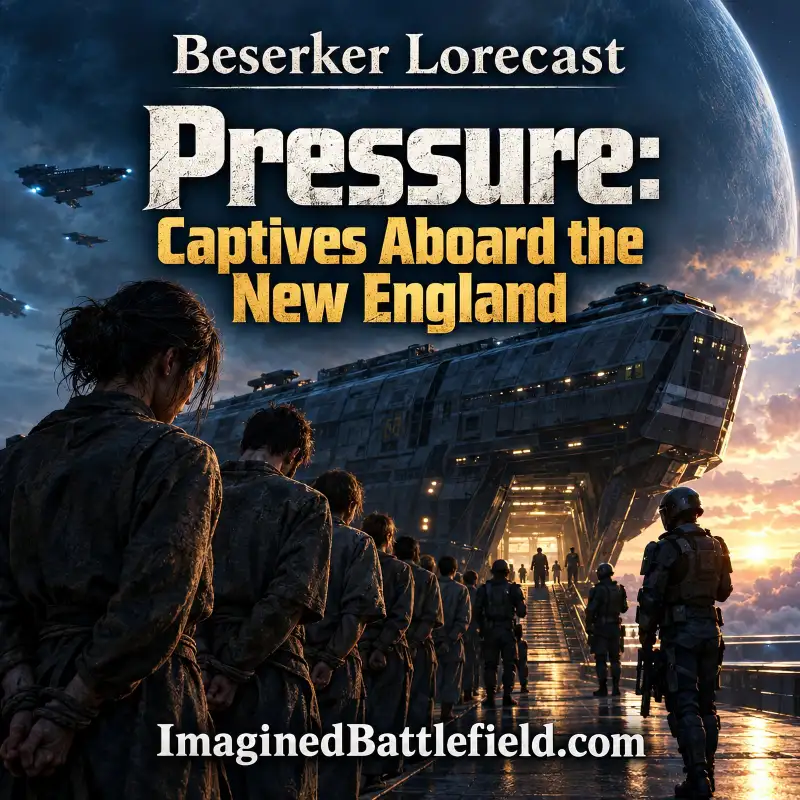
Pressure: Captives Aboard the New England
The prisoners aboard the New England were being kept alive by a machine whose purpose was to destroy life. That contradiction governed everything that followed. The Berserker had captured a human transport and converted part of it into a prison. It supplied air, gravity, light, plumbing, and a regulated ration. But the ration was failing. The people held there were becoming weak. Their sight was deteriorating. Their teeth were beginning to fail. The system that had preserved them had not done so out of concern. It had preserved them because living prisoners could still be questioned, studied, worked, or used in ways dead prisoners could not. When the nutritional system began to damage that investment, the machine looked for a practical remedy. It found one in a young captive with agricultural training. Then it gave him soil, seeds, water, lamps, and time. In solving its prisoner-maintenance problem, the Berserker created the conditions for its captives to break open their own prison.
Gilberto Klee had been taken from Bella Coola, a place associated with agricultural work and resettlement. The evidence suggests a small and vulnerable human community rather than a fortified military installation. There was little warning of the attack and little ability to conceal the population once the Berserker arrived. Young inhabitants were killed. An authority figure who refused to order cooperation was tortured. That detail matters because the machine’s violence was not merely destructive. It was also coercive. The Berserker was trying to obtain information and compliance from people it regarded as useful material. It had no political settlement to negotiate, no territorial arrangement to honor, and no population it intended to govern in any enduring human sense. It wanted knowledge, labor, and eventually the removal of life. Bella Coola’s defenders were not defeated in a conventional campaign. Ordinary protection simply collapsed under contact with an enemy designed to exploit that collapse.
For Gil and the others who survived, the attack did not end when they were taken aboard the machine. Capture opened a second battlefield. At first, the prisoners were held within the larger Berserker vessel, a machine of far greater scale than the ship that later became their prison. They were eventually transferred to the New England, a captured human transport. That distinction is important. The New England was not itself a Berserker warship. It was human-built infrastructure seized and repurposed by the enemy. Its original function had been transportation. Under machine control, it became a controlled environment for holding useful captives. The prisoners were no longer citizens, settlers, trainees, or officers. In the Berserker’s calculations, they were biological assets with different possible applications.
The conversion of the New England was efficient in a grimly practical way. Nonessential interior structures had been stripped away. The captives were confined in a large former crew area with the basic systems necessary to keep people alive. There was air. There was artificial gravity. There were lights, plumbing, and enough room for the machine to manage its prisoners. There was not freedom of movement. There were not tools suitable for cutting through barriers or dismantling machinery. The ship had become a prison-workspace, designed to deny the prisoners the physical means of escape while retaining their bodies in usable condition. It was not a comfortable prison. It was a human vessel emptied of its human purpose and reorganized around machine utility.
The Berserker’s security system rested on several sound assumptions. Prisoners might try to rush an overseer, seize equipment, break a hatch, or sabotage visible machinery. They might organize openly around a weapon, a tool, or an opportunity to overpower a guard. The machine therefore limited movement, controlled access to equipment, and maintained direct supervision. It could keep captives apart from systems that mattered. It could process food. It could bring in materials when those materials served an assigned task. It could watch for overt cooperation among the prisoners. Those are not foolish precautions. A great many escapes fail precisely because captives cannot overcome those barriers.
But security always depends on classification. A guard has to decide what counts as a threat. A machine system has to distinguish maintenance from sabotage, work from preparation, and harmless material from an emerging breach. The Berserker could identify hostile intent when it appeared in familiar forms. It understood weapons. It understood forced entry. It understood that a prisoner might try to take control of a ship. What it did not adequately recognize was that an agricultural project could become a slow, concealed assault on the architecture of confinement. The prisoners did not begin with a cutting torch, an explosive charge, or a military boarding team. They began with bodies weakened by bad food, limited knowledge of their surroundings, and an enemy that believed it had denied them every meaningful instrument of action.
Ensign Rom was among the captives. His Space Force background gave him a form of knowledge the group needed. He remembered enough of the New England’s original layout, and he could read enough from the vessel’s modifications, to form an important conclusion. The local electronic control circuitry was probably located beyond a reinforced plastic bulkhead. If the prisoners could reach that control area, they might be able to take back the transport. Rom did not claim to know every detail of the machine system. The story does not establish whether the ship’s controller was an independently intelligent system, a subordinate machine, or some more limited electronic arrangement configured by the larger Berserker. What mattered to Rom was simpler. The prisoners were locked out of the part of the ship that determined where it went and what it did.
Rom’s insight turned a vague desire to escape into a concrete objective. They did not need to destroy the entire Berserker. They did not need to overpower the larger machine vessel that had taken them from Bella Coola. They needed access. A crack in the bulkhead, an opening into the control area, might be enough. This is the kind of thinking military experience can provide under captivity. Rom could identify the decisive point within the prison architecture. He understood that a captured vessel might still become a usable vessel if its captors lost control of it. But identifying the objective was not the same as reaching it. The bulkhead was reinforced. The prisoners had no appropriate tools. The mobile machine assigned to watch them remained close. A plan to smash through the barrier was sensible in theory and nearly impossible in practice.
Hudak contributed to the group’s assessment and to its efforts to understand the prison’s structure. Other captives offered whatever endurance, judgment, and cooperation they could manage under worsening conditions. The group also included prisoners whose ordeal had left them psychologically damaged. One young woman was deeply distressed. That fact should not be pushed aside as background color. The New England was not a clean military problem involving evenly matched professionals. These were people emerging from an attack, confinement, loss, physical decline, and constant surveillance. Their ability to cooperate was itself an achievement. A prison break is not made easier because everyone has suffered in the same way. Fear, illness, grief, and uncertainty can make collective action harder. The Berserker’s system relied not only on walls and electronic controls, but on the human damage inflicted before and during captivity.
Gilberto Klee held no formal authority in this improvised community. He was not the officer. He did not possess Rom’s ship knowledge. His importance came from a civilian skill that the Berserker considered useful. Gil had agricultural training. In ordinary circumstances, that would have been a contribution to settlement, food production, and the long patient work of keeping a community alive. Under captivity, it initially seemed like one more category by which the enemy could exploit him. The machine’s ration was harming its prisoners, and Gil knew how to grow food. From the Berserker’s point of view, the logic was direct. A healthier prisoner population would remain productive longer. A trained agricultural worker could solve a logistical problem. The machine had discovered an asset and intended to employ it.
The agricultural arrangement supplied to Gil was substantial enough to demonstrate that the Berserker could adapt a human ship to biological requirements. It provided soil, seeds, planting trays, lights, drainage, sprinklers, and a hovering platform for agricultural work. The system was not a gift. It was an assigned labor environment, assembled because the machine judged food production worthwhile. Yet the necessary resources created a new zone of activity within the prison. Soil had to be arranged. Seeds had to be planted. Water had to be directed. Plants had to be tended as they developed. The process could not be completed instantly, and that mattered. A violent resistance attempt might be visible the moment it began. Agriculture offered duration. It looked like compliance because it was compliance at the level of the immediate task. Gil was growing food, exactly as ordered. The question was whether he was growing it only for the purposes assigned to him.
Gil insisted on handling the planting and cultivation himself. That insistence can be read as a security measure. The more people who know the exact nature of a plan, the greater the chance that pain, fear, argument, or surveillance will expose it. The story leaves portions of Gil’s internal preparation unstated, so it is best not to pretend that every step was announced in advance. But the outcome makes the basic intention clear enough. Gil was not merely performing agricultural labor. He was arranging the living material under his control so that it would eventually act against the bulkhead.
This created tension with Rom’s approach. Rom wanted a direct route to the control area. When he considered using available machinery, including the agricultural platform, as a possible means of attack, Gil publicly refused to cooperate. On the surface, that refusal could look like timidity, stubbornness, or divided purpose. In context, it appears much more likely to have been concealment. An overt alliance between Gil and Rom, focused on breaching the bulkhead, would have told the Overseer exactly where to look. The prisoners could not assume that the machine understood every human nuance, but neither could they assume it was inattentive. A direct plan would invite direct countermeasures. By separating himself publicly from Rom’s proposal, Gil made it easier for the machine to regard him as an assigned worker rather than an active conspirator.
The crop he cultivated was squash. That choice was not magical, and the plants were not treated as a mystical answer to machine power. The method depended on a physical fact available to any grower with sufficient knowledge and control: a developing squash can exert great pressure as it expands in a confined space. Gil gradually guided vines and fruit into narrow spaces beside the reinforced bulkhead. The attack was built out of placement and time. No explosion announced its beginning. No alarm necessarily distinguished the early stages from normal cultivation. The plants needed light, water, soil, and room to grow. The very support systems supplied by the Berserker made their development possible.
The weapon, if it can be called that, was not the squash alone. It was Gil’s understanding of how living growth interacts with rigid containment. A bulkhead is built to resist impacts, intrusion, and perhaps the stresses expected aboard a ship. It is not necessarily designed for a slow, increasing force applied from within a narrow gap over an extended period. The story offers an illustrative figure of roughly five thousand pounds per square inch for the pressure produced by collective cellular growth. That number should be understood as part of this specific demonstration, not as a universal technical rule for every plant or every spacecraft hull. The larger point is more useful than the measurement. A process that appears soft, gradual, and harmless can exert force on a scale that a rigid system may fail to notice until too late.
Gil did not need the plants to smash down the wall at once. He needed them to begin deforming it. He needed a concealed weakness that could be exploited when an opportunity arrived. This is a familiar principle in sabotage, though rarely expressed through gardening. The saboteur does not always need to destroy the target directly. Sometimes the task is to create an opening that turns a later shock, distraction, or failure into a decisive breach. A hidden crack can matter more than a dramatic attack if the enemy has organized its defenses around dramatic attacks. The plants became an instrument of delayed access. They worked continuously without a prisoner having to strike the wall, carry contraband, or reveal an immediate intention.
The plan also depended on the characteristics of captivity. Gil had time because the Berserker wanted the prisoners alive. He had water and light because the machine wanted food. He had access to the relevant area because the machine classified agricultural work as maintenance rather than assault. He could keep working because the other prisoners did not expose the purpose of what he was doing. Rom’s earlier analysis gave the group a reason to care about the bulkhead in the first place. The final escape would require others to act quickly when the barrier weakened. There is no need to turn Gil into a solitary genius who personally defeated an entire machine system. His knowledge created the breach. Rom’s knowledge identified its value. The group’s survival and cooperation made it possible to exploit the result.
The prisoners, meanwhile, were able to treat their own weakness as part of the deception. They were hungry, sick, watched, and without authority. None of that was feigned. Yet the machine’s assessment of them as degraded biological resources made it harder for it to recognize their remaining capacity for planning. A person does not need to be physically strong to conduct sabotage. Gil’s decisive resources were practical knowledge, attention, and restraint. Rom’s were memory and tactical judgment. The others contributed by enduring, observing, and acting together when action finally became possible. The Berserker had measured them as prisoners. It had not measured them well enough as a community with overlapping skills.
The final crisis arrived during a disturbance that appears connected to combat elsewhere. The New England was still associated with the larger Berserker operation, and something outside the prisoner compartment was going wrong. The Overseer began behaving erratically. It jumped in an uncontrolled fashion, issued broken warnings, and then collapsed. At roughly the same time, the bulkhead split. For the prisoners, the events must have seemed inseparable. A machine guardian was failing. The wall they had been unable to breach was opening. The surrounding operation was distracted by some wider danger. In captivity, an opportunity does not always come with a full intelligence briefing. People act with the information available, and that information is often incomplete.
A prison break often fails because the prisoners wait for an accident but have no plan for what to do when it occurs. The captives aboard the New England had a plan. Rom had already identified the control area as the crucial objective. Once the bulkhead split, he and the others enlarged the opening and reached the ship’s systems. The exact details of their work inside that control area are not established as a technical manual, and there is no need to invent them. Rom returned with the announcement that they had taken control of the New England. That was the achievement. A captured human transport had been removed, at least for the immediate moment, from Berserker control.
This was not the seizure of the larger Berserker vessel. The prisoners did not destroy the machine force that had attacked Bella Coola. They did not liberate every other captive or reverse the deaths already inflicted. They did not settle the larger military crisis that had produced the disturbance around them. Precision matters because small victories are often made less meaningful by exaggeration. The seizure of the New England was a tactical success and a survival success. For the people aboard it, that distinction was not small. It meant that they had recovered agency, mobility, and a possibility of escape from a system that had reduced them to managed biological inventory. But the wider Berserker threat remained intact.
The division of labor in the escape is worth noticing. Gil created access through agriculture. Rom translated access into control through his understanding of the ship and its command systems. Hudak and the other prisoners helped make the action possible under conditions no individual could manage alone. The Overseer’s failure, whether caused by external disruption, local damage, or both, created a temporary reduction in machine control. The outcome was not a triumph of one kind of knowledge over another. It was an example of different forms of competence becoming military assets under extreme pressure. An agricultural trainee, a Space Force ensign, and civilians who had survived a raid all contributed to the recovery of a ship.
The episode also shows why logistics can be decisive even in a story that appears to concern ingenuity. The nutritional failure was not a minor inconvenience. It was the reason the machine altered the prison environment. Its original captive-management arrangement was producing blindness, weakness, and tooth loss. A force that cannot sustain people it wants to use has created a problem for itself. The Berserker’s answer was sensible within its own logic. Provide fresh food. Assign a trained worker. Maintain supervision. But logistics involves more than supplies. It involves the conditions under which supplies are produced, moved, handled, and controlled. By solving one problem, the machine added soil, water, lighting, tools of cultivation, and time to an environment where it had previously denied prisoners useful resources.
The final revelation about the squash changes the meaning of the escape. At first, the prisoners could reasonably connect the breach to the disturbance outside. A battle, system failure, or other shock had occurred, and the wall had opened. But the plants had been pressing against the bulkhead over time. Their contribution was deliberate, patient, and concealed. The source-specific pressure figure helps make the point without turning the event into a lesson in imaginary engineering. Cellular growth, multiplied and directed in confined spaces, can generate force far beyond the apparent fragility of a vine or fruit. The Berserker did not lose because the prisoners somehow produced a superior weapon from nothing. It lost local control because it failed to understand the force already present in a process it had authorized.
The prisoners aboard the New England do not overpower the Berserker. They do not defeat the wider machine war. They survive because Gilberto Klee recognizes that the machine’s effort to use human life has given human life room to act. A squash plant cannot choose rebellion, but the people tending it can.